Why Your Hotel Workout Plan Fails on Multi City Trips
Quick Answer: Single-destination trips fail on motivation; multi-city trips fail on variance. Every new hotel resets the variables - room size, gym availability, floor type, noise constraints, schedule, and time zone - so any plan that depends on a specific environment breaks at the first hotel that does not match it. The fix is to carry a plan that has zero environmental dependencies: one bodyweight circuit that fits in 6 by 6 feet, is silent, needs no equipment, and takes 20 minutes. Do that in every city and treat any hotel gym you find as a bonus, not as the plan.
You trained well on the last trip. This one is four cities in six days and you have done nothing since the first morning.
The difference is not discipline. It is that you brought a plan with dependencies.

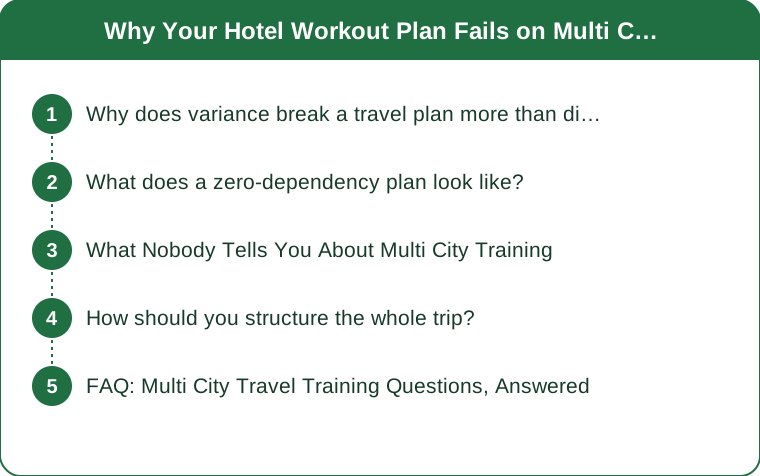
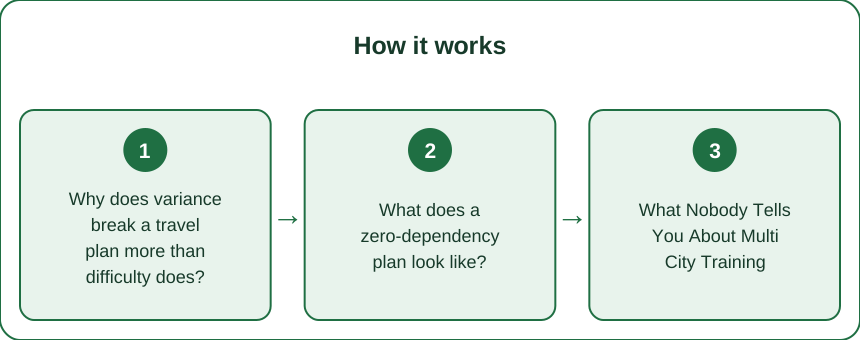
Why does variance break a travel plan more than difficulty does?
Because every dependency in your plan is a chance for that day’s workout to not happen.
A plan that requires a hotel gym has one dependency. A plan that requires a hotel gym with dumbbells over 25 pounds has two. A plan requiring a gym, a specific piece of equipment, and a 6am opening time has three - and on a four-hotel trip, that is twelve independent chances to fail.
On a single-destination trip, you check the facilities once and adapt once. The adaptation cost is paid one time and the rest of the week runs on the new normal.
On a multi-city trip, you pay that cost every single morning, in an unfamiliar room, usually with less sleep, often before an early start. The decision fatigue alone is enough to lose most sessions.
The failure mode is specific and recognizable: you arrive, you plan to scope out the gym, you get in late, the morning is compressed, you decide to do it tonight, the evening runs long, and the day is gone. Repeat in the next city.
The insight that fixes it: on a multi-city trip, the value of a plan is not how good it is but how many environments it survives unchanged. A mediocre workout you do four times beats an excellent one you do once.
What does a zero-dependency plan look like?
One circuit, 6 by 6 feet, silent, no equipment, 20 minutes, memorized.
Memorized matters. If it requires opening an app, finding a video, or reading a phone, that is a dependency too - and a weak one at 6am in an unfamiliar room with hotel wifi.
A structure that works: five movements, 45 seconds each, 15 seconds transition, five rounds. Squats, push-ups, reverse lunges, a hip hinge variation, and a plank or dead bug. That is 20 minutes exactly, it covers every major movement pattern, and it requires nothing but floor.
Silent is non-negotiable on a multi-city trip because you have no idea what is below you, and you will often be training early. No jumping, no dropping, no burpees. Impact through a hotel floor at 6am is the fastest way to a phone call.
6 by 6 feet is the real constraint. Many business hotel rooms have less clear floor than people expect once the bed, desk and luggage rack are accounted for. Test your circuit at home in a taped-out 6 by 6 square - if a movement does not fit, replace it now rather than discovering it in Frankfurt.
And it should scale by effort, not by equipment. The same circuit should be doable at 60 percent on a bad day and genuinely hard at 100 percent, so you never need a different plan for a low-energy morning.

What Nobody Tells You About Multi City Training
The first morning in each city is the only one that reliably exists. Schedules compress as a trip progresses, evenings get taken by dinners, and the assumption that you will train later in the stay is almost always wrong. Train on arrival morning in every city and treat anything else as extra.
Time zone changes make the second and third days worse, not the first. Jet lag effects on subjective energy typically deepen after the first night rather than immediately - the adrenaline of arrival masks it. Plan your hardest session for the first morning, not the third.
Packing for the gym you hope exists is a trap. Trainers, shorts and a lifting item take real luggage space, and on a multi-city trip they get carried unused across four flights. A pair of trainers is worth packing; anything beyond that usually is not. A single resistance band is the exception - it is the highest value-to-volume item in travel fitness by a wide margin.
Hotel gyms are worse the more you need them. The pattern most business travelers notice is that budget and conference hotels - the ones you stay in most on multi-city trips - have the least equipment and the most crowding at exactly the hours you are free. Planning around them is planning around the least reliable resource in the building.
Walking is a genuinely underrated multi-city strategy. Arriving in a new city and walking for 45 minutes handles light activity, daylight exposure for circadian adjustment, and orientation for the rest of the stay. It is the one session that gets better with each new city rather than harder.
How should you structure the whole trip?
Fixed circuit every arrival morning, walking as the connective tissue, and lower total volume than at home.
Train the arrival morning in each city. This is the single highest-yield rule. It happens before the schedule takes over, it is a fixed trigger that requires no decision, and it means a four-city trip has four guaranteed sessions.
Use daylight walking for circadian adjustment, particularly when crossing time zones. Morning light in the new time zone accelerates adjustment, and a walk delivers it while also being useful activity.
Deliberately reduce total volume. A travel week is not the week to attempt maintenance-plus. Strength is retained for considerably longer than most people fear - a week or two at reduced volume causes minimal detraining - so the goal is continuity of habit, not stimulus.
Do not chase the missed session. The compensatory instinct after skipping a day is to do a longer session the next, which on a trip usually produces one hard session followed by two skipped ones. Same circuit, every arrival morning, regardless of what happened yesterday.
Pack the resistance band and the trainers. Nothing else. The band adds pulling movements, which are the main gap in a bodyweight circuit, and it weighs almost nothing.
And plan the first workout home. The session after a multi-city trip is reliably terrible - accumulated sleep debt, dehydration and disrupted circadian rhythm all land at once. Schedule something easy and deliberately short, because a bad first session back is the most common trigger for a week off after a trip that otherwise went fine.
FAQ: Multi City Travel Training Questions, Answered
Is it worth checking hotel gym facilities before booking?
On a single-destination trip, sometimes. On a multi-city trip, rarely - the time cost of researching four hotels is real, the information is often inaccurate, and you should not be depending on the gym anyway. Check once you arrive and treat anything good as a bonus for that city.
How much fitness do I actually lose on a ten day trip?
Very little in strength terms - meaningful strength detraining takes considerably longer than most people assume, and a week or two of reduced training is largely recoverable within a session or two. Cardiovascular fitness declines somewhat faster but is still modest over ten days. The real costs of a travel week are sleep debt, hydration and habit disruption, which is why continuity matters more than intensity.
Should I train on travel days themselves?
A short session on a travel morning is often more valuable than the same session on a static day, because it counteracts the prolonged sitting. But keep it brief and low intensity - a hard session followed by six hours in a plane seat is a reliable recipe for stiffness and poor sleep. Ten minutes of movement plus walking through the airport is a reasonable travel day target.
What is the single most useful item to pack?
A long resistance band with handles or a loop. It weighs almost nothing, packs flat, and adds the pulling patterns - rows, pull-aparts, face pulls - that a bodyweight circuit in a hotel room otherwise cannot cover. If you pack one non-clothing fitness item for a multi-city trip, that is it.
TL;DR:
- Multi-city trips fail on variance, not motivation - every dependency in your plan is a fresh chance to skip.
- Carry one memorized circuit: 6 by 6 feet, silent, no equipment, 20 minutes, scalable by effort.
- Train the arrival morning in every city. Later in the stay almost never happens.
- Plan the hardest session for day one - jet lag deepens on nights two and three.
- Hotel gyms are least reliable in exactly the hotels multi-city trips use. Treat one as a bonus.
- Walking handles activity, daylight and orientation at the same time, and it works in every city.
- Pack trainers and a resistance band. Nothing else earns its luggage space.
A mediocre circuit done four times beats an excellent one done once.
Keep Reading
This article is for general informational and styling purposes only. Fit, sizing, and product availability may vary.