Why Your Hotel Workout Should Be Different on Day One, Day Three, and Day Five
Quick Answer: Day one should be mobility and easy movement, not a workout - you are dehydrated, compressed from sitting, and often sleep-disrupted. Days two and three are your best training days and where any hard session belongs. From day four onward, accumulated sleep debt and poor food usually make intensity counterproductive, so shift back to movement and maintenance. Planning that arc in advance beats trying to hit the same session every day and failing by Wednesday.
You packed the bands and planned to train every day.
By Thursday you have done one session and feel worse than if you had planned three good ones.

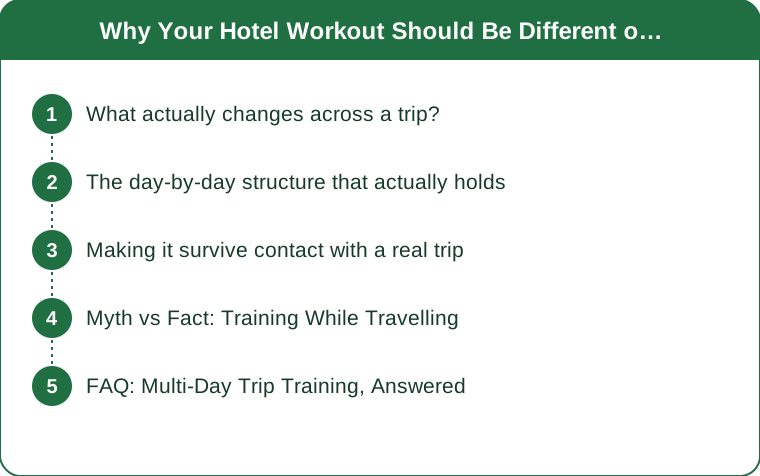
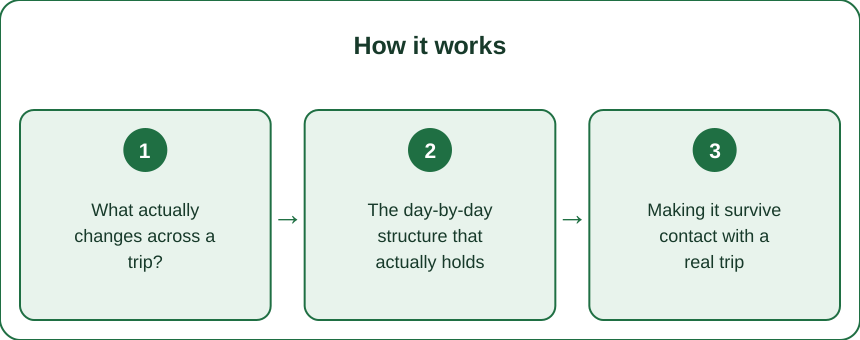
What actually changes across a trip?
Day one is the worst training day and people treat it as the best. Travel means hours of sitting, dehydration from cabin air or driving, disrupted meal timing, and often a short night. None of that is a good foundation for intensity.
Sleep debt accumulates rather than resolving. Unfamiliar beds, different noise, and a schedule that is not yours mean most people sleep worse across the whole trip, and the deficit compounds day over day.
Time zone shifts affect performance for days, roughly one day per hour of shift for full adjustment. Even a two-hour change is enough to move your natural training window meaningfully.
Food quality and timing degrade predictably. Conference catering, restaurant meals, and irregular timing mean by day four you are often under-fuelled in ways you would not be at home.
Sitting accumulates too. Long meetings on top of long travel produce hip and thoracic stiffness that builds through the week, which is why day five mobility work feels more necessary than day one.
And motivation follows a predictable curve - high on day one, lowest on days three and four. Planning the easiest session for the lowest-motivation day is simply working with that rather than against it.
The day-by-day structure that actually holds
Day one: movement, not training. Fifteen to twenty minutes of mobility, walking, and easy bodyweight work. Hips, thoracic spine, ankles, and shoulders - everything that just spent hours compressed in a seat.
This is not a compromise session. It genuinely improves how days two and three go, and it is the session most likely to actually happen because the barrier is so low.
Days two and three: your real training. If you are doing one hard session on a trip, it belongs here. You have adjusted somewhat, sleep debt has not accumulated much, and motivation is still available.
Make it full-body and time-efficient - 25 to 35 minutes, compound movements, minimal equipment. This is where a hotel gym or a resistance band session earns its place.
Day four onward: maintenance and movement. Shorter sessions, lower intensity, and a bias toward mobility and walking rather than hard intervals.
This is counterintuitive if you feel you are falling behind, and it is what prevents the run-down state that makes the first week back home unproductive.
Day of return: movement only. Another travel day, another set of hours sitting. Treat it like day one rather than like a training day, and save the real session for the day after.
Walking is the through-line across all of it. It is the highest-value travel exercise, requires nothing, and doubles as a way to actually see wherever you are.

Making it survive contact with a real trip
Decide the arc before you leave, not each morning in the hotel room. Morning decisions under sleep debt reliably produce no session at all.
Put the sessions in your calendar like meetings, particularly the day two and three ones. A session with a time attached happens considerably more often than a session with an intention attached.
Train before the day starts on work trips. Evening plans get taken by dinners and overrunning meetings almost every time, and the morning is the only reliably controllable window.
Keep the kit minimal and visible. A resistance band and a pair of trainers, unpacked and in sight, removes the two most common friction points.
Have a five-minute version of every session. On the day it does not happen, five minutes preserves the habit, and the habit is what makes the next trip easier.
Hydrate deliberately on travel days, since dehydration accounts for a surprising share of how bad day one feels. This is the least glamorous item on the list and among the most effective.
And plan the first session back home as an easy one. The day you return is not a training day, and the day after tends to be worse than expected - starting easy is how you avoid a week of feeling behind.
Myth vs Fact: Training While Travelling
Myth: Train hard on day one to set the tone. Fact: day one is your worst-prepared day - dehydrated, compressed from sitting, and often short of sleep. Mobility on day one makes days two and three genuinely better.
Myth: Missing sessions on a trip sets you back. Fact: a week of reduced training has minimal effect on fitness. What actually sets people back is arriving home run down from trying to train hard on no sleep.
Myth: You need the hotel gym. Fact: a resistance band, the floor, and a chair cover almost everything for a week. The gym is a convenience, not a requirement, and it is frequently occupied anyway.
Myth: Evening is fine for training on work trips. Fact: evenings get taken by dinners and overrunning meetings with high reliability. Morning is the only window you actually control.
Myth: A short session is not worth doing. Fact: five to fifteen minutes preserves the habit and improves how you feel through a day of sitting. The habit is worth more across a year than any single session.
Myth: You should keep your normal programme while away. Fact: trying to replicate a home programme with different equipment, worse sleep, and less time is the most common reason travel training fails entirely.
FAQ: Multi-Day Trip Training, Answered
What should I do on the first day of a trip?
Mobility and easy movement, fifteen to twenty minutes - hips, thoracic spine, ankles, shoulders. You are dehydrated and compressed from sitting, which is a poor foundation for intensity.
When is the best day to train hard?
Days two and three. You have adjusted somewhat, sleep debt has not accumulated much, and motivation is still available.
Why should I ease off later in the trip?
Sleep debt accumulates, food quality declines, and sitting adds up. Pushing intensity from day four is what produces the run-down state that ruins the first week back.
Morning or evening on a work trip?
Morning, almost always. Evenings get taken by dinners and overrunning meetings, and the morning is the only window you genuinely control.
What is the minimum useful equipment?
A resistance band and trainers. The floor, a chair, and a bed cover everything else for a week of training.
Will a week of light training set me back?
No. A week of reduced load has minimal effect on fitness. Arriving home exhausted from forcing sessions is the thing that actually costs you.
What about the day I fly home?
Treat it like day one - movement only. Plan the first real session for the day after, and make it an easy one.
TL;DR:
- Day one is your worst training day: mobility and walking, not intensity.
- Days two and three are the best window - put any hard session there, 25 to 35 minutes, full body.
- From day four, shift to maintenance and movement as sleep debt and poor food accumulate.
- Decide the arc before you leave, put sessions in the calendar, and train in the morning on work trips.
- Travel home days are day one again - plan the first session back as an easy one.
A week of light training costs you nothing. Arriving home run down costs you the following week too.
Keep Reading
This article is for general informational and styling purposes only. Fit, sizing, and product availability may vary.