Why the Workout You Planned on the Plane Never Happens
Quick Answer: Plans made in transit fail because they are made without the information that determines whether a session happens — actual room size, actual schedule, actual energy after arrival. The fix is to plan a decision rule rather than a workout: a specific trigger, a minimum version, and a single fallback that works in any room. Detail is the enemy here.
This is general information, not medical advice.

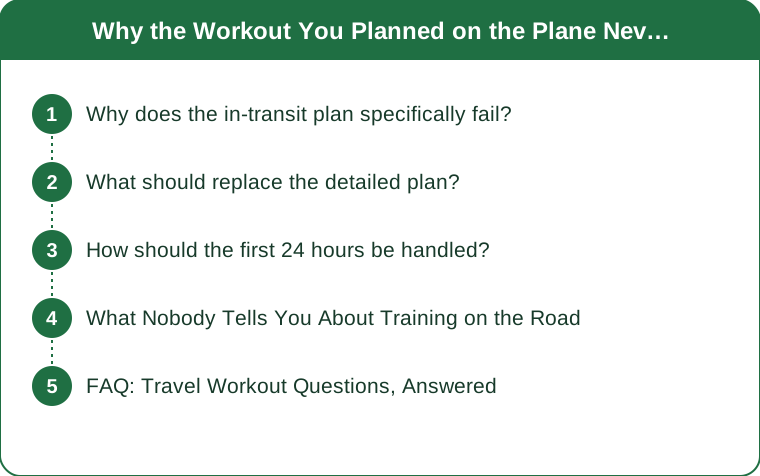
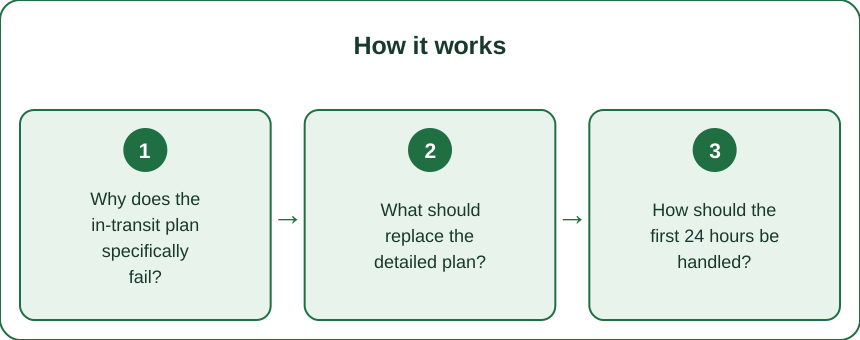
Why does the in-transit plan specifically fail?
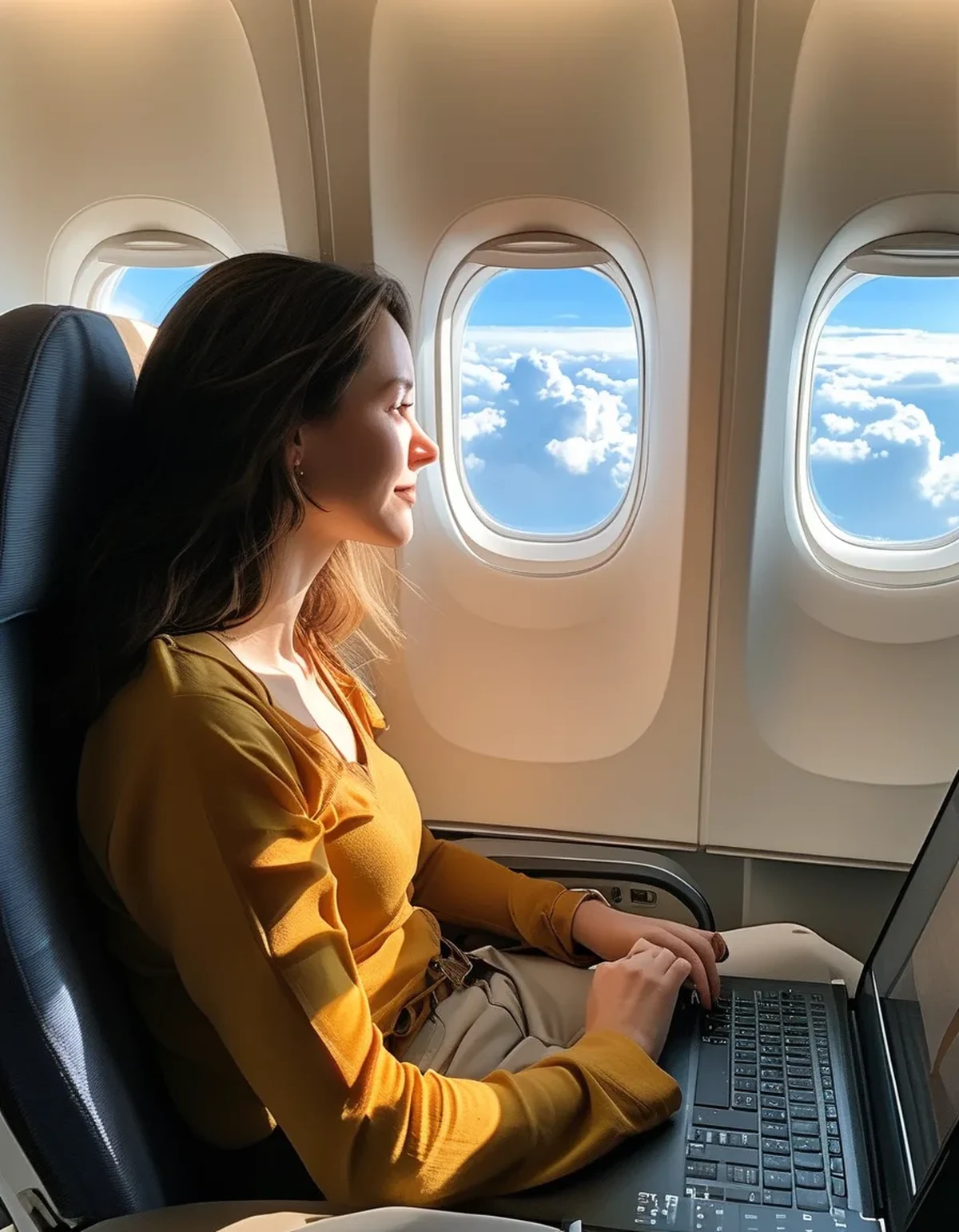
You are planning for a person you have not met yet. Post-flight you is more tired, more dehydrated, and on a different clock than the person writing the plan.
The plan assumes facilities you have not seen. Hotel gym photographs are marketing, and a large share of hotel gyms are a treadmill, a bike and dumbbells up to 10kg.
It assumes a schedule that has not happened. Travel days run late, meetings overrun, and the 6pm session becomes an 8pm session becomes nothing.
Planning feels like progress. Writing a detailed plan produces a genuine sense of accomplishment, which paradoxically reduces the urgency to execute it. This is well documented and it applies precisely here.
What should replace the detailed plan?
A trigger, not a time. “Before I open the laptop” or “immediately after checking in” is far more robust than “6pm”, because it attaches to an event that will definitely happen.
A minimum version you would never skip. Ten minutes, bodyweight, in the room. The minimum is not the goal; it is the thing that removes the all-or-nothing decision.
One fallback that works anywhere. A single circuit you know by heart, needing no equipment and about two square metres. Same one every trip.
A specific first movement. Deciding in advance that you start with 20 bodyweight squats removes the hardest moment, which is the first thirty seconds.
Nothing else. Sets, reps and progression schemes are for home. On the road, attendance is the metric.
How should the first 24 hours be handled?
Do something on arrival day, however small. The first session sets the pattern for the trip, and skipping it makes the second day easier to skip too.
Keep it low intensity after a long flight. Dehydration, disrupted sleep and prolonged sitting all reduce capacity, and a hard session on arrival commonly produces two bad days rather than one good one.
Walk, first. A 20-minute walk outdoors on arrival helps with circadian adjustment through light exposure, helps with the stiffness, and counts as the session if nothing else happens.
Get daylight at the local morning if you can. Light timing is the most effective tool available for adjusting to a new time zone, and it makes every subsequent day’s training more likely.
Hydrate more than feels necessary. Cabin air is very dry and most people arrive meaningfully under-hydrated, which affects both how the first session feels and how well you sleep.
What Nobody Tells You About Training on the Road
Consistency across the trip beats quality on any day of it. Six ten-minute sessions across a week does more for the habit — and for how you feel by Friday — than one excellent gym session on day three.
The gap is smaller than you fear. A week of reduced training costs very little in fitness terms. The real cost of a bad travel week is the difficulty of restarting afterwards, which is a habit problem rather than a physiological one.
Packing kit you never use is a specific kind of demoralising. Take less than you think and use it, rather than carrying a full kit as a statement of intent.
The hotel gym is often busiest at exactly the hour everyone plans to use it. 6 to 8am on weekdays in business hotels. Shifting by 45 minutes usually gets you an empty room.
Room workouts have a noise problem nobody mentions. Jumping in a hotel room at 6am is inconsiderate to whoever is below. Low-impact formats are not just a preference on the road.
And the one that changes trips: deciding in advance that the trip’s goal is three short sessions, not five good ones, makes the trip a success rather than a failure. The target was the problem, not the execution.
FAQ: Travel Workout Questions, Answered
Is it worth training at all on a three-day trip?
For fitness, marginally. For sleep, energy and how the trip feels, considerably. Short sessions on short trips are about function rather than progression.
Should I train on local time or home time?
Local time, as soon as possible, and use morning daylight to shift. Training at home-time hours prolongs the adjustment.
What if the hotel has no gym and no floor space?
A doorway, a wall and a chair cover a full session: wall sits, split squats with the rear foot on the chair, incline push-ups, and step-ups. That is enough for a genuine 20 minutes.
TL;DR:
- Plans made in transit assume facilities, energy and a schedule you do not yet have.
- Replace the plan with a trigger, a ten-minute minimum, and one equipment-free fallback.
- Do something on arrival day, keep it easy, and get outdoor daylight at local morning.
- Consistency across the trip matters more than quality on any single day.
- Set the goal at three short sessions, not five good ones.
The plane plan was never the problem. Planning instead of deciding was.
This is general information, not medical advice.
Keep Reading
This article is for general informational and styling purposes only. Fit, sizing, and product availability may vary.