Why Your First Workout Back Home After a Trip Feels So Bad
Quick Answer: The first session home feels terrible because of accumulated sleep debt, dehydration from flying, disrupted circadian timing, and several days of unusual eating — not because you lost fitness. Muscular strength barely changes in a week. Plan the first session back at about 60 to 70 percent of normal volume, keep it familiar, and expect normal performance within two to four days.
You did the hotel room workout. Twice, actually.
And on day one back, your normal warm-up weight feels like a working set.
Here is everything that is actually going on, and how to schedule around it.

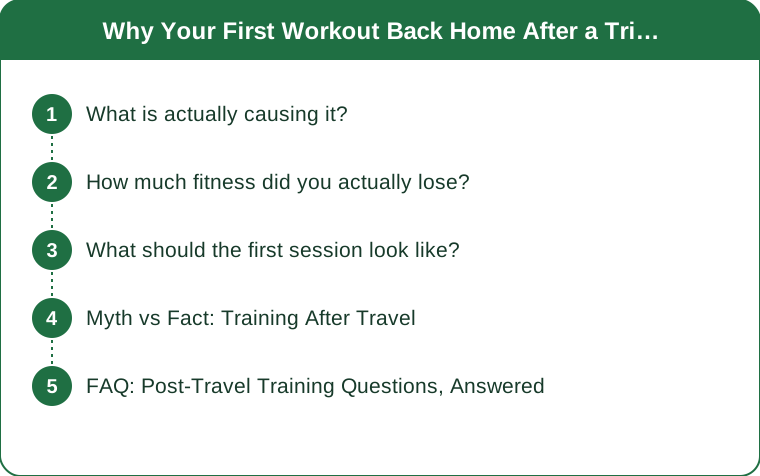
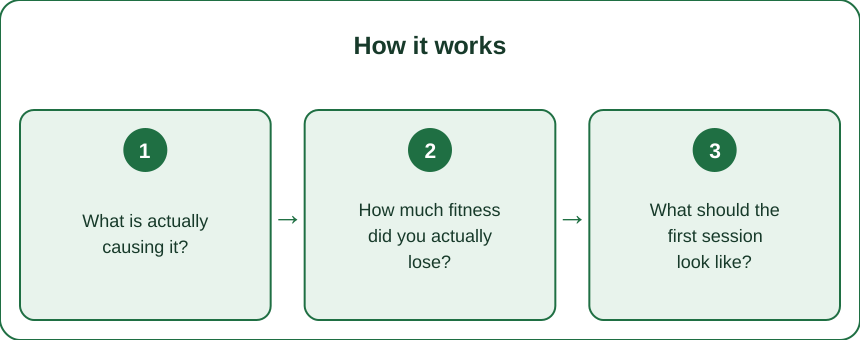
What is actually causing it?
Five things, none of which is lost fitness.
Sleep debt is the biggest single factor. Travel almost always costs sleep — early flights, unfamiliar beds, noise, different temperature, and a schedule that is not yours. Sleep loss raises perceived effort at a fixed workload, reduces the ability to repeat high-intensity efforts, and impairs coordination. A session that is objectively identical genuinely feels much harder.
You are probably dehydrated. Cabin air is extremely dry, and most people drink less water and more alcohol and coffee while travelling. Even mild dehydration reduces blood volume, which raises heart rate at any given workload and makes everything feel harder.
Circadian rhythm disruption affects performance directly. Physical performance follows a daily rhythm, generally peaking in the late afternoon and early evening. After crossing time zones, your internal clock is still on the old schedule, so training at 7am local time might be landing at 2am internal time. Even a two-hour shift is enough to matter.
Eating was different for several days. Less consistent carbohydrate intake, unusual meal timing and often lower total intake mean muscle glycogen is likely depleted. Glycogen is what fuels moderate and high-intensity work, and low stores feel exactly like being unfit.
You sat still for a long time. Long flights and long drives leave you stiff, with reduced tissue tolerance and often a genuinely tight lower back and hips. The first session asks tissue that has been compressed for hours to move well immediately.
How much fitness did you actually lose?
Very little, and knowing this changes how you approach the session.
Strength is remarkably durable over short breaks. Meaningful strength loss generally takes considerably longer than a week or two of reduced training, and a fortnight off produces small measurable changes at most. If you trained at all while away, the number is essentially zero.
Aerobic fitness declines faster than strength but still not in a week. Detectable reductions in aerobic capacity typically need two or more weeks of complete inactivity.
What you lose fastest is the sharpness and coordination, not the underlying capacity. Movement patterns feel rusty after a week away, which is why familiar lifts feel technically off even when the weight is well within your strength.
Glycogen and hydration are the real difference, and they restore fast. Both can be largely corrected in one to two days of normal eating and drinking, which is why the second or third session back usually feels dramatically better than the first.
The gap between what you feel and what you lost is the actual problem. People conclude they detrained, respond by hammering a punishing session to make up for it, and end up sore, discouraged and sometimes injured — a much larger setback than the trip caused.

What should the first session look like?
Deliberately modest, familiar and early enough to reset your schedule.
Aim for about 60 to 70 percent of your normal volume. Same movements, fewer sets, lighter loads. This is enough stimulus to re-establish the routine without producing three days of soreness.
Keep it familiar. Not the session to try a new programme, a new class, or a heavy test. Familiar patterns feel better and give you an honest read on where you actually are.
Warm up considerably longer than usual. Ten to fifteen minutes, with more general movement than normal, particularly for hips, thoracic spine and ankles after long periods of sitting.
Prioritise timing over intensity if you crossed time zones. Training in the morning in daylight after eastward travel helps shift your clock, and getting the schedule back is worth more this week than the training stimulus is.
Hydrate deliberately for 24 hours first, and include some sodium. Water alone on top of a travel deficit tends to pass straight through.
Expect to feel normal by session two or three. Most people are back within two to four days. If you are still flat after a week, look at sleep and food rather than at training.
A note on the season: returning from a late-summer trip to a cooler home climate adds another variable — training in noticeably cooler air after a week in the heat changes how everything feels, usually for the better after the first couple of days. Do not read the first session’s difficulty as evidence about the whole autumn.
Myth vs Fact: Training After Travel
Myth: You need a hard session to get back on track. Fact: You need a completed session. The purpose of the first one back is re-establishing the routine, and difficulty is irrelevant to that.
Myth: Feeling weak means you detrained. Fact: It almost always means you slept badly and are underfuelled. Strength does not go anywhere in a week.
Myth: You should make up the missed sessions. Fact: Adding volume to a body already carrying travel fatigue is how people get injured in the week after a holiday. Resume the normal schedule; the missed sessions are gone and they cost you almost nothing.
Myth: Training immediately fixes jet lag. Fact: Light exposure and meal timing do more for circadian adjustment than exercise does. Exercise helps mainly by getting you outdoors in daylight at the right time.
Myth: The scale tells you what happened. Fact: Post-travel weight changes are overwhelmingly water and glycogen, both of which swing several pounds in either direction within days. It tells you nothing useful this week.
FAQ: Post-Travel Training Questions, Answered
How long until I feel normal again?
Usually two to four days, roughly matching how long it takes to restore sleep, hydration and glycogen. Long-haul travel across many time zones can take a week or more.
Should I train on the day I get back?
A walk or an easy session is often useful for adjusting to the new time zone, particularly outdoors in daylight. A hard session on arrival day rarely goes well.
What if I did not train at all while away?
Still start at 60 to 70 percent. A week or two off produces very little actual loss, and the main risk is doing too much too soon.
How do I minimise this next time?
Protect sleep over training while away, hydrate deliberately on flights, and get outdoor light at the destination in the morning. Two or three short sessions on a trip is plenty.
Is soreness after the first session back normal?
Some, yes — you are returning to unfamiliar loading. Severe soreness usually means the first session was too ambitious.
Should I weigh myself when I get home?
If it does not bother you, fine, but expect a meaningless number for several days. Wait a week for anything you would act on.
TL;DR:
- The first session back is hard because of sleep debt, dehydration, circadian disruption and low glycogen — not lost fitness.
- Strength barely changes in a week. Aerobic capacity needs two or more weeks off to decline measurably.
- Plan the first session at 60 to 70 percent volume, familiar movements, longer warm-up.
- Hydrate with some sodium for 24 hours first, and get outdoor morning light if you crossed time zones.
- Do not try to make up missed sessions. That is where the injuries happen.
By session three you will wonder what the fuss was about. Do not let session one convince you otherwise.
Keep Reading
This article is for general informational and styling purposes only. Fit, sizing, and product availability may vary.