Why Hotel Workouts Feel Nearly Impossible the Night You Land (And What Actually Works Instead)
Quick Answer: Post-flight fatigue is a real physiological state, not just low motivation — dehydration, disrupted circadian signals, and hours of immobility all lower your actual capacity for that evening. A 10-minute mobility-focused session, not a full workout, is the version that actually happens and still helps.
You pack your workout clothes with real intentions, and then arrival evening happens and the plan quietly dies. That’s not a willpower failure — travel does something measurable to your body that a normal ‘just push through it’ pep talk doesn’t account for.
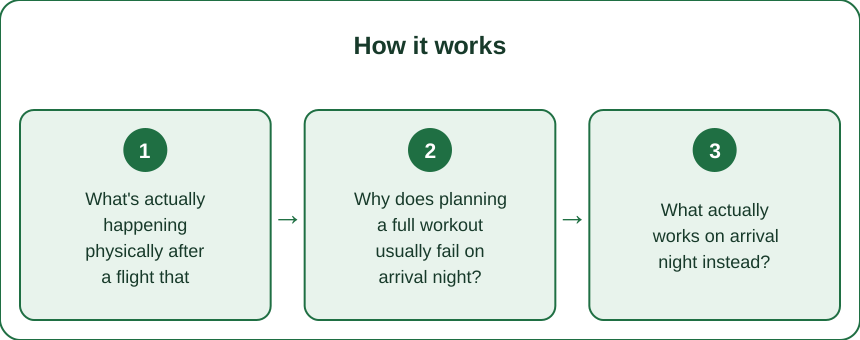
What’s actually happening physically after a flight that kills workout motivation?
Hours of sitting reduce circulation and stiffen hip flexors and lower back muscles specifically. Cabin air is low-humidity, contributing to mild dehydration that shows up as fatigue and brain fog. Combined with a disrupted eating and sleep schedule, your body is genuinely operating with less available energy than a normal evening — this isn’t purely psychological.
Why does planning a full workout usually fail on arrival night?
The gap between a planned 45-minute workout and actual post-flight capacity is usually too large to close, so the plan gets abandoned entirely rather than scaled down. Setting the bar at a full session creates an all-or-nothing trap where ‘not enough energy for the whole thing’ becomes ‘skip it completely.‘

What actually works on arrival night instead?
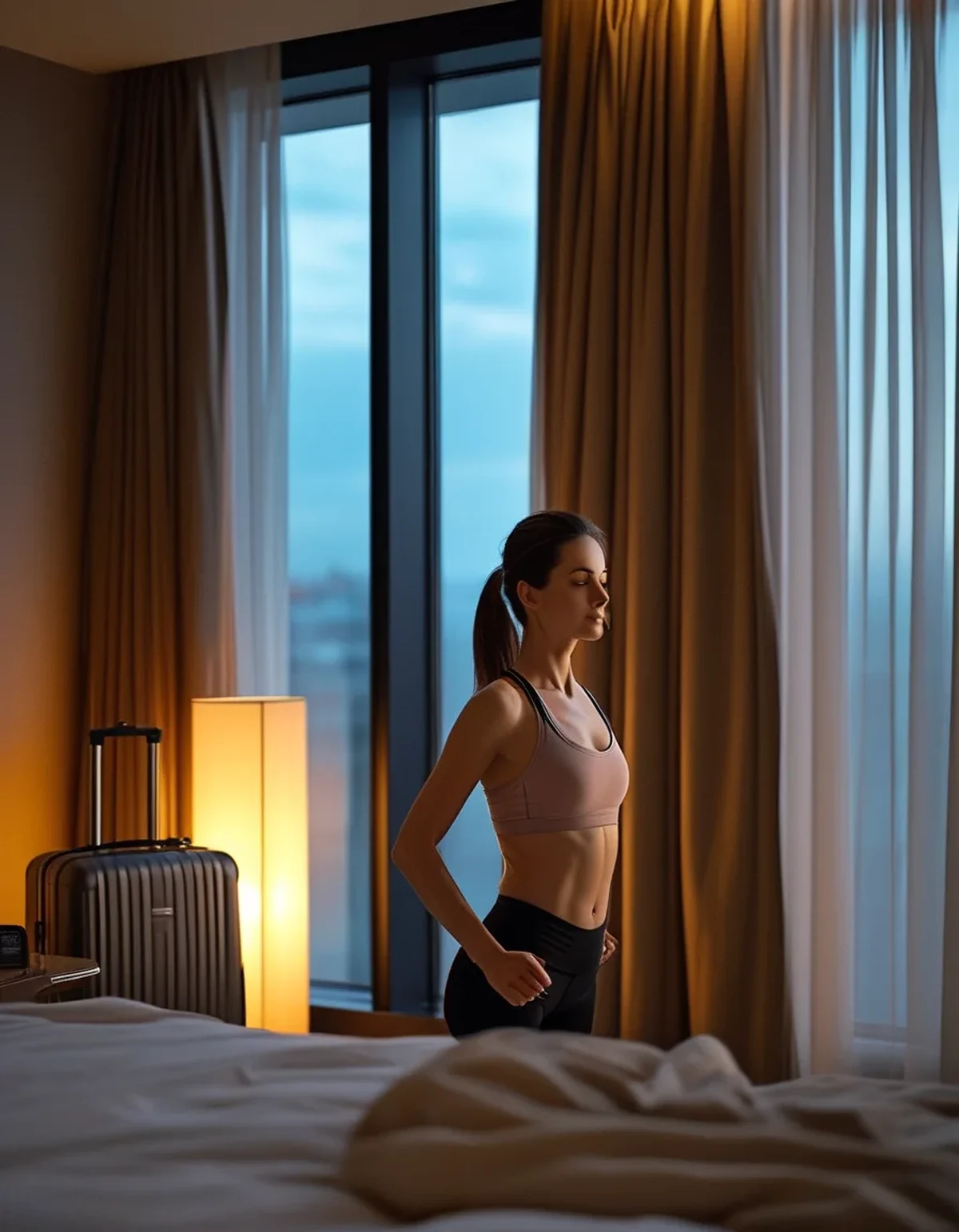
A 10-minute mobility and light movement session — hip flexor stretches, a few bodyweight squats, some light rotational core work — targets exactly what a flight stiffens without demanding energy you don’t have. This isn’t a lesser version of ‘real’ exercise for travel days; it’s the specifically correct tool for what your body needs after hours of sitting.
Does hydration before the session actually change how it feels?
Yes, meaningfully — rehydrating with water (not just the in-flight beverage service) for an hour or two before attempting any movement noticeably reduces the heavy, foggy feeling that makes even light movement feel harder than it should. Most travelers underestimate how much of arrival-night fatigue is simple dehydration.
FAQ: Post-Flight Hotel Workout Questions, Answered
Is it better to skip the workout entirely and just sleep on arrival night?
For very late arrivals or overnight flights, yes — sleep takes priority; the 10-minute mobility version is for a normal daytime or early-evening arrival with reasonable energy left.
Does time zone change matter for when to do this?
Somewhat — aligning light movement with the destination’s evening (rather than your body clock’s ‘3am’) helps reset your circadian rhythm slightly faster, on top of the physical benefits.
Should I still plan a full workout for the next morning?
Yes — arrival night’s light session isn’t a replacement for your regular training, just a bridge; most travelers find a real workout is very achievable by the following morning once basic rehydration and sleep have happened.
TL;DR:
- Post-flight fatigue is physiological — dehydration and hours of stillness genuinely lower your capacity
- Planning a full workout on arrival night usually fails because the gap to actual energy is too large
- A 10-minute mobility session targets exactly what sitting stiffens, without requiring energy you don’t have
- Rehydrate an hour or two before attempting movement — it changes how the session actually feels
Keep Reading
This article is for general informational and styling purposes only. Fit, sizing, and product availability may vary.