What to Do When the Hotel Gym Is Always Full
Quick Answer: Hotel gyms have extremely predictable peaks: 6 to 8am and 5 to 7pm on weekdays, driven almost entirely by business travelers. The reliably empty windows are before 6am, 10am to 4pm, and after 8:30pm. If you cannot move your session, the plan B that beats waiting is a 20-minute room circuit or the hotel stairwell, both of which need no equipment and no queue. Ask the front desk about nearby gym day passes too - many hotels have arrangements they never advertise.
The wasted twenty minutes standing in the doorway deciding is the actual problem, and it is solved by deciding in advance.

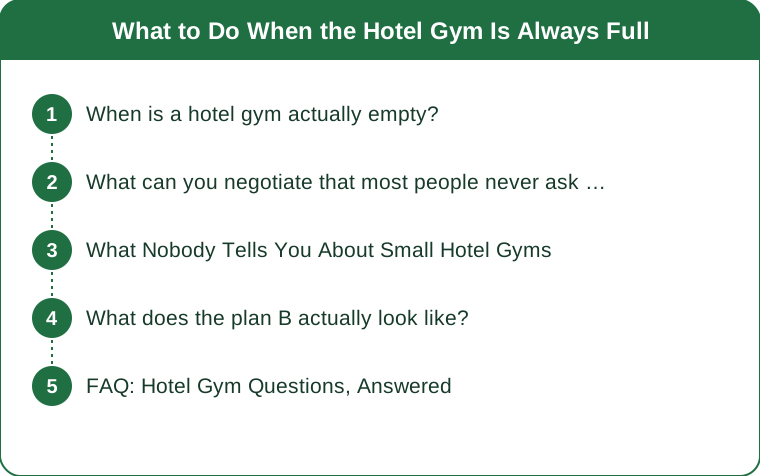
When is a hotel gym actually empty?
The pattern is remarkably consistent across business hotels.
The morning peak runs 6 to 8am, and it is sharp. Business travelers train before meetings, and a six-station gym can have ten people in it at 6:45.
A second peak runs 5 to 7pm, as people return from meetings. Usually slightly less intense than the morning but longer.
Genuinely empty windows: before 6am, 10am to 4pm, and after 8:30pm. Mid-morning is the most reliably empty and the least used, because almost everyone is out.
Weekends invert the pattern. Leisure travelers train later, so the weekend peak is roughly 8 to 11am and evenings are often quiet.
Conference hotels are the exception and can be brutal. A hotel hosting a large conference will have a gym under permanent siege for the duration - check whether there is an event on when you check in, and plan for the room workout for the whole stay if there is.
Practical move: ask at check-in when the gym is busiest. The front desk knows precisely, nobody asks, and the answer takes ten seconds.
What can you negotiate that most people never ask about?
More than you would expect, and it costs one conversation.
Nearby gym partnerships. Many hotels have arrangements with local gyms for discounted or free day passes, and it is frequently not advertised anywhere. Ask specifically - the answer is yes more often than the website suggests.
Equipment loans to the room. Plenty of hotels will send up a yoga mat, a set of dumbbells, or resistance bands on request. Many list it nowhere.
Off-hours access. Some gyms with posted hours will provide key access outside them for guests who ask, particularly at smaller properties.
Pool access as an alternative. If there is a pool, it is almost always emptier than the gym at exactly the times the gym is busiest.
Local drop-in options. Day passes at nearby chains typically run $15 to $25, and boutique studios often have a first-class discount for visitors. A single conversation at the front desk usually surfaces two or three options, which is a much better return than another morning spent waiting for the one treadmill.

What Nobody Tells You About Small Hotel Gyms
The dumbbells almost always stop at 25 pounds. Plan for higher reps, slower tempo, and unilateral work rather than expecting to train the way you do at home. A 25-pound dumbbell in a slow split squat is a genuinely hard set.
The single bench is the real bottleneck, not the machines. If you build your session around the bench, you will spend it waiting. Build around floor and standing work and the gym gets much less crowded, immediately.
Treadmills are the most contested item by a wide margin. If your session is cardio and the gym is full, the stairwell or a run outside solves it entirely - and a hotel stairwell is one of the better conditioning tools available.
The room is bigger than it looks. Most hotel rooms have 6 x 8 feet of usable floor space once you move a chair, which is enough for a complete bodyweight session. The constraint is usually noise, not space - avoid jumping, and everything else is available.
Nobody is watching you in the gym. The self-consciousness about doing floor work in a small shared space in front of strangers is nearly universal, and everyone in that room is thinking about their own session.
Bring bands, not weights. A set of resistance bands weighs a few ounces, packs flat, and removes the equipment problem permanently. It is the single best travel fitness purchase, and it makes the gym-availability question mostly irrelevant.
And the first workout of a trip is the one that matters. Skipping it because the gym was busy tends to become skipping the whole trip - which is why having a decided plan B beats having a preference.
What does the plan B actually look like?
Two options, both fifteen to twenty-five minutes, neither requiring a queue.
Option 1: the room circuit. Five exercises, 45 seconds work and 15 seconds rest, four rounds. Squats or split squats, push-ups (hands on the bed for an easier version, feet on the bed for a harder one), glute bridges, plank shoulder taps, and reverse lunges. Twenty minutes, no equipment, no noise beyond footsteps.
Add bands if you have them: banded rows around a door handle, banded pull-aparts, and banded lateral walks fill the gaps a bodyweight circuit leaves - especially horizontal pulling, which is otherwise hard to hit in a hotel room.
Option 2: the stairwell. Ten to fifteen rounds of walking or jogging up 4 to 6 flights with the elevator or a walk down as recovery. Hotel stairwells are almost always empty, air-conditioned, and safe, and stair intervals are among the most efficient conditioning available. Check the door does not lock behind you first - and carry your key card.
Combine them for a full session: 15 minutes of stairs, then 10 minutes of the room circuit. That is a legitimately hard 25 minutes with no equipment and no waiting.
Then decide the night before. Look at the gym on your way past in the evening, ask the desk about peak hours, and pick your window and your plan B before you go to bed. The plan made in advance is the one that survives a 6:30am gym with eleven people in it.
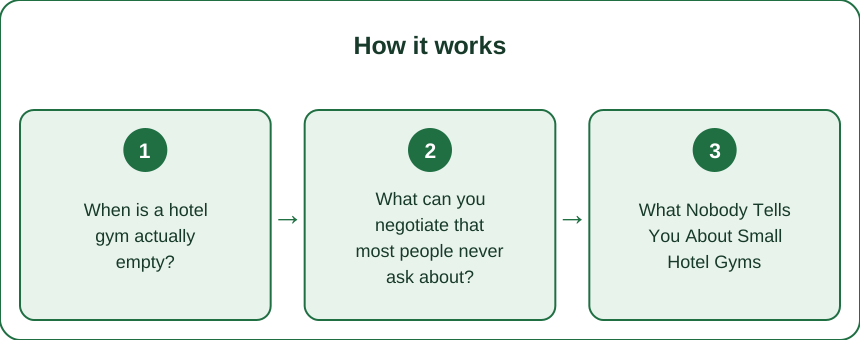
FAQ: Hotel Gym Questions, Answered
Is it rude to ask someone how long they will be on a machine?
Not at all - it is standard gym etiquette everywhere. Most people will tell you their remaining time and many will offer to work in with you, particularly on a bench.
Can I work out in the hotel room without disturbing the room below?
Yes, if you avoid jumping and high-impact work. Squats, lunges, push-ups, planks, and band work generate almost no noise. Save plyometrics for the stairwell or outside.
Are hotel gym hours negotiable?
Often, especially at smaller hotels. Asking the front desk about early or late access costs nothing, and key-card access outside posted hours is more common than the signage suggests.
What is the single best thing to pack?
A set of resistance bands with a door anchor. They weigh almost nothing, take no space, and cover horizontal pulling and lateral work that a bodyweight-only room session cannot reach.
TL;DR:
- Hotel gym peaks are 6 to 8am and 5 to 7pm on weekdays; the empty windows are before 6am, 10am to 4pm, and after 8:30pm.
- Ask the front desk about peak times, day-pass partnerships, and equipment loans - most of it is unadvertised.
- Build sessions around floor and standing work, not the single bench, and expect dumbbells to stop at 25 pounds.
- Plan B: a 20-minute room circuit or stair intervals - both beat waiting, and both need no equipment.
Decide your window and your plan B the night before. The trips where training falls apart are almost never the ones with bad gyms - they are the ones where the first morning was busy and there was no second option ready.
Keep Reading
This article is for general informational and styling purposes only. Fit, sizing, and product availability may vary.