The Hotel Workout for When Your Luggage Didn't Arrive
Quick Answer: You need none of what’s in that suitcase. A barefoot-friendly, low-impact session using the bed, a chair, and a wall covers legs, push, pull, and core in 20 minutes — and doing it in whatever you flew in is fine. Skip anything with jumping or lateral cutting, since carpet and bare feet are a bad combination for those, and prioritize movement over intensity if you also flew today.
The bag is in another city and the airline says tomorrow. Your gym clothes, your shoes, and your resistance bands are all in it.
None of that was load-bearing. Here’s the session.
What actually changes without shoes and kit?
Less than you’d think, and the constraints are specific rather than general.
Barefoot on carpet rules out impact and lateral movement. No jumping, no burpees, no skaters, no anything that requires you to cut sideways. Carpet grabs unpredictably and there’s no ankle support. This isn’t a comfort note — twisted ankles on hotel carpet are a real way to make a bad travel day worse.
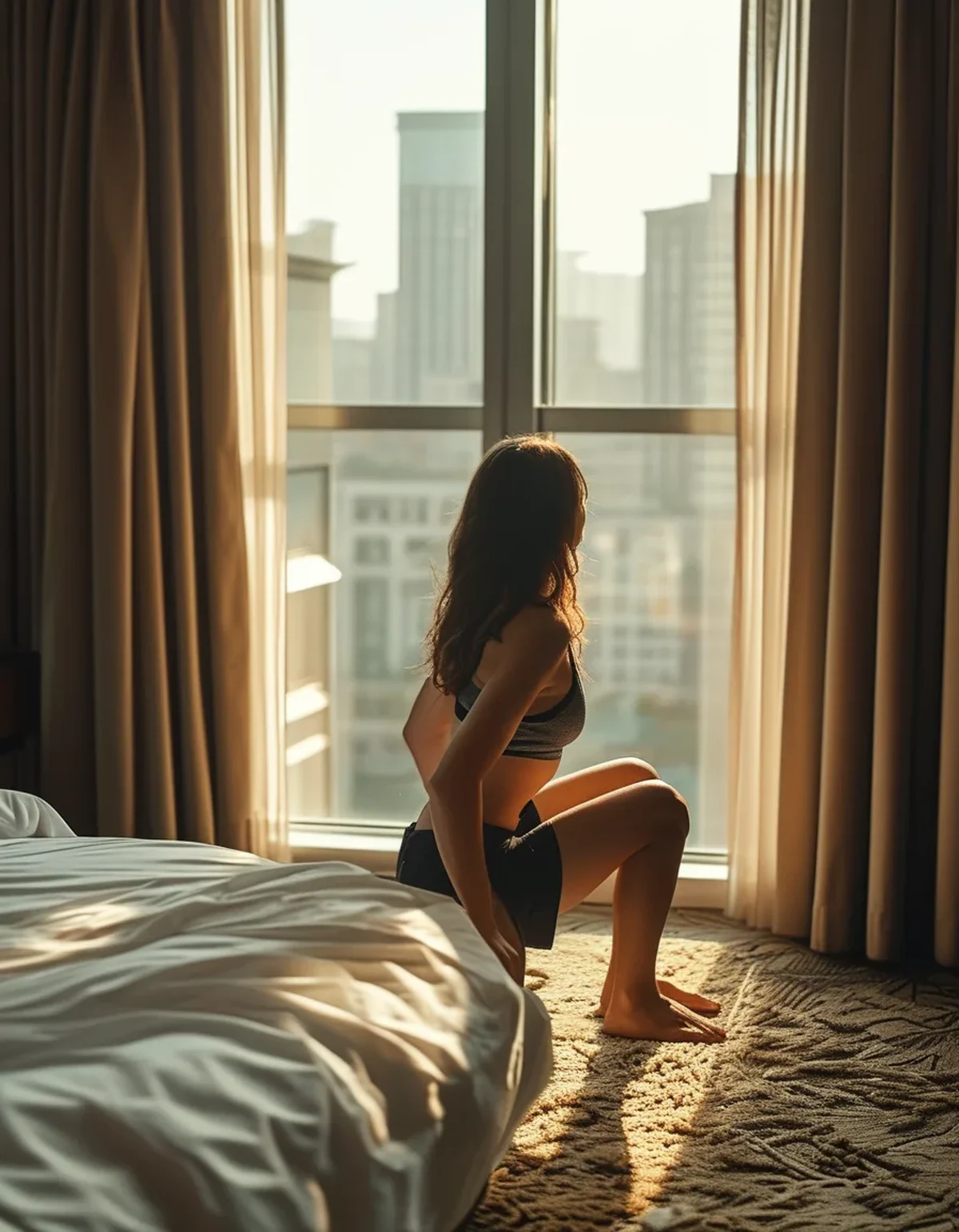
Barefoot is genuinely fine for everything else. Squats, lunges, hinges, push-ups, and core work are all safe and in some ways better without shoes, since you get more direct feedback from the floor.
Clothing matters less than you fear. Trousers or jeans limit deep squats and high knee lifts. Work in the range you have rather than forcing depth. Underwear plus a t-shirt in a private hotel room is completely reasonable and removes the constraint entirely.
Sweat is the real consideration. If you have exactly one set of clothes until tomorrow, keep the intensity moderate and the session short. Twenty controlled minutes beats a session that leaves you with nothing to wear to dinner.
The 20-minute session
Three rounds, six movements, roughly 45 seconds each with brief transitions. No equipment beyond the room’s furniture.
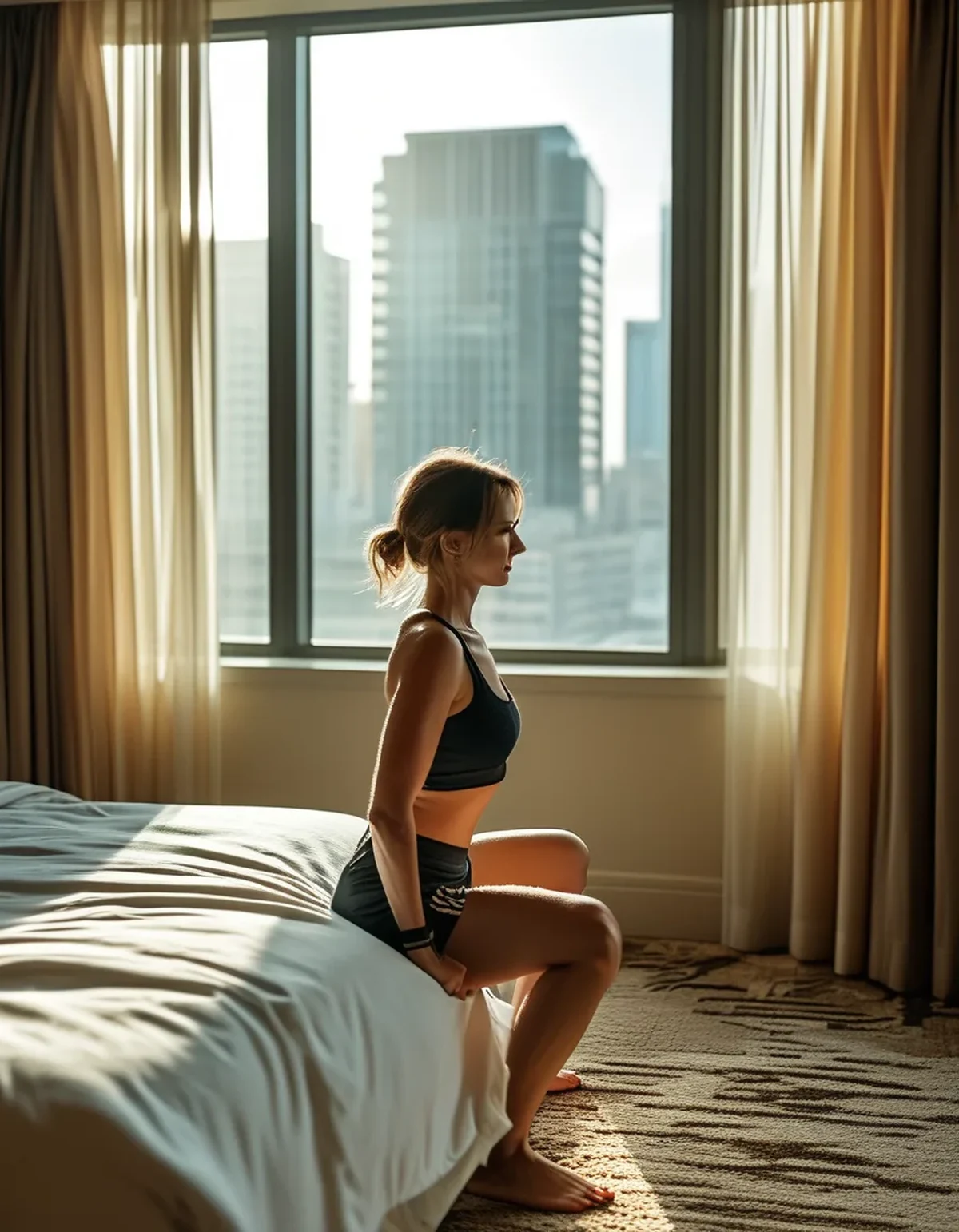
1. Bodyweight squats — feet shoulder-width, sit back and down to whatever depth your clothes allow, stand tall. Slow on the way down, controlled on the way up. If you’re in jeans, a half-depth squat done well is a real exercise.
2. Incline push-ups, hands on the desk or the bed’s edge — the desk gives you a firmer surface and a harder angle; the bed is easier and more forgiving on the wrists. Either works. Keep a straight line from head to heels.
3. Split squats, rear foot on the chair — 45 seconds per leg. This is the hardest movement here and the one that does the most for you. Hold the wall for balance if you need it.
4. Wall sit — back flat against the wall, thighs as close to parallel as your clothing permits. Silent, no impact, and genuinely difficult past 30 seconds.
5. Glute bridges on the floor — feet flat, drive through the heels, squeeze at the top for a full second. Counteracts hours of sitting on a plane, which is probably why your back feels the way it does.
6. Dead bug or plank — dead bug if the floor is comfortable, plank on forearms if you’d rather. Slow and controlled.
Rest 60 seconds between rounds. Three rounds is 20 minutes with transitions.
What Nobody Tells You About Training After a Travel Day
The advice is always to get moving right away to beat jet lag. It’s mostly right, and it usually skips the part that matters.
You’re more dehydrated than you feel. Cabin air is extremely dry, and a long flight leaves most people meaningfully down on fluid. That shows up as a higher heart rate at a given effort, earlier fatigue, and a session that feels much harder than it should. Drink a full glass of water before you start and expect the effort to read high.
Your joints have been folded for hours. Sitting compressed for a long flight leaves hips tight and the thoracic spine stiff. Going straight into deep ranges is how people tweak something on day one of a trip. Move through the first round deliberately at partial range and let the range come back.
The goal on arrival day is different. You’re not training for adaptation — you’re moving to help with circulation, stiffness, and sleep timing. A gentle 15 minutes accomplishes that entirely. Trying to make it a real session on arrival day is the classic mistake that wastes the following two days.
Timing helps with jet lag more than intensity does. Movement in the local daytime, ideally with daylight, supports the clock adjustment. A short walk outside in the afternoon light is worth more for jet lag than anything you do on the hotel carpet — do both if you can.
What to buy if you’re stuck for more than a day
If the bag is genuinely gone for several days, three cheap purchases restore almost everything.
A resistance band, about $15. Available at most pharmacies and general stores. This single item brings back all your pulling movements — rows, pull-aparts, pull-downs anchored in the door — which is the one real gap in the bodyweight session above.
Any pair of shoes with a flat sole, if you plan to do anything outdoors. You don’t need running shoes to walk, and walking outside in daylight is the highest-value thing you can do for jet lag.
A t-shirt and shorts, about $25. Mostly so you’re not washing one set of clothes in the sink every night. This is a quality-of-life purchase rather than a training one, and it’s usually worth it by day two.
What not to bother with: anything heavy, anything you’d have to check on the way home, and a gym day pass if the hotel gym is free and adequate. And do file the airline claim — most carriers reimburse reasonable interim purchases with receipts, so keep them.
FAQ: No-Kit Travel Workout Questions, Answered
Is training barefoot on hotel carpet safe?
For squats, lunges, push-ups, and core work, yes. Avoid anything with jumping or lateral cutting — carpet grip is inconsistent and there’s no ankle support. Check the floor for anything sharp first, especially near the desk.
Should I use the hotel gym instead if there is one?
If you have anything resembling appropriate shoes, yes — it’s a better environment and you’ll train harder. Most hotel gyms require closed-toe shoes as a policy, which is exactly the thing in your missing bag.
Will one or two missed sessions actually matter?
No. Fitness doesn’t measurably decline over a few days, and the real risk of a disrupted trip is the habit break rather than the physiology. That’s the actual argument for doing something in the room — it keeps the pattern intact, which is worth more than the session itself.
TL;DR:
- No shoes and no kit rules out impact and lateral movement, and almost nothing else.
- Six movements using the bed, a chair, and a wall covers legs, push, and core in 20 minutes.
- On arrival day, go lighter than usual — flight dehydration and stiff hips make everything read harder.
- Stuck longer? A $15 resistance band restores every pulling movement you’re missing.
- Keep receipts; most airlines reimburse reasonable interim purchases.
Run the three rounds tonight, then get outside in daylight tomorrow afternoon. The bag will turn up, and the trip won’t have cost you the habit.
Keep Reading
This article is for general informational and styling purposes only. Fit, sizing, and product availability may vary.