How to Train in a Hotel Room When You Are Sharing It
Quick Answer: Sharing a room removes three things a hotel workout normally relies on: floor space, noise tolerance, and the willingness to look silly. The workable answer is a 15-minute session built entirely from quiet, low-footprint, standing and supported movements - no jumping, no floor sprawl, no equipment - done at a time you have agreed rather than negotiated in the moment.
The constraint is social far more than physical, and the schedule matters more than the exercises.

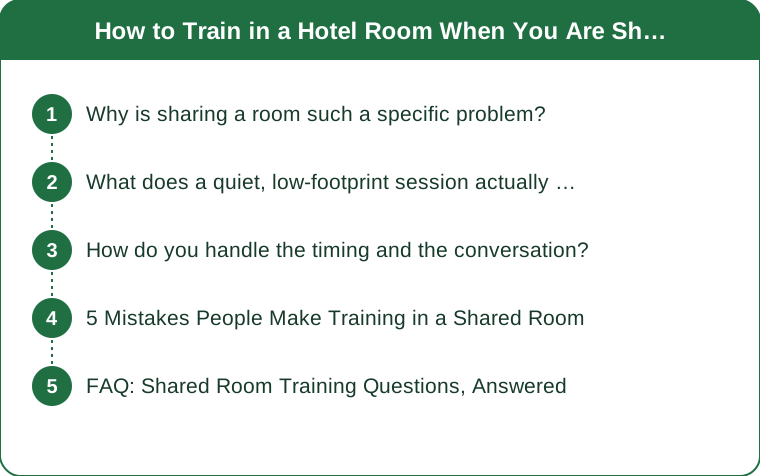
Why is sharing a room such a specific problem?
Because it removes the three things that make in-room training viable, all at once.
The floor is gone. A single room with two people has two suitcases, two sets of shoes, and one usable strip of carpet. Anything requiring you to lie down and move limbs freely - most core work, most mobility flows - is off the table. The available footprint is roughly the size of a bath towel, standing.
Noise tolerance drops to zero. Alone, you might tolerate your own thumping. With someone else in the room, especially someone working, sleeping, or on a call, every impact is an imposition. That rules out jumping, high knees, mountain climbers, and anything where a hand or foot strikes the floor at speed.
Self-consciousness is real and worth naming. People skip hotel workouts with a colleague in the room mainly because it feels awkward, not because it is impractical. Pretending that is not a factor leads to plans that never get executed. Designing for a session that does not look strange is a legitimate constraint.
The honest conclusion: do not try to do your normal workout quietly. Build a different session that is quiet by design. Attempting a muted version of a normal session produces something both compromised and still disruptive.
What does a quiet, low-footprint session actually contain?
Standing movements, supported movements, and isometrics. Roughly 15 minutes, no equipment, no floor sprawl.
Round structure: 45 seconds work, 15 seconds transition, six exercises, three rounds. Total 18 minutes including a brief warm-up.
- Reverse lunges - stepping back rather than forward keeps you in one spot and is quieter than a walking version. Alternate legs.
- Wall sit - completely silent, genuinely hard, and requires a wall you already have.
- Incline push-ups against the desk or windowsill - quieter than floor push-ups and adjustable in difficulty by changing the height.
- Split squats with the rear foot on the bed - the bed is the single most useful piece of equipment in a hotel room and this is the best use of it.
- Standing march with a slow tempo - a controlled knee lift, three seconds up and three down. Looks unremarkable, works the hip flexors and trunk properly.
- Wall plank or forearm plank on the desk - trunk work without needing floor space or getting down on the carpet.
Every one of these can be done in a one-metre square, none involves impact, and none of them look particularly odd if someone glances over.
To make it harder without adding noise: slow the tempo. A five-second lowering phase on a split squat is substantially more demanding than a normal-speed one and makes no additional sound. Tempo is the volume knob for quiet training, and it is the tool most people forget they have.

How do you handle the timing and the conversation?
Better than hoping for a gap, which is what most people do.
Agree the window in advance, on day one. A single sentence when you check in: I am going to do fifteen minutes in the room at 6:45 each morning, shout if that is a problem. It converts a recurring awkward negotiation into one short exchange, and colleagues almost always say fine.
Pick the window with the fewest collisions. Early morning before the other person is properly up, or the twenty minutes after returning to the room in the evening before anyone settles. The worst windows are anything overlapping with calls, and the hour before bed.
Use the bathroom as an overflow space. Not glamorous, and genuinely useful for a few minutes of mobility or a quiet set when the room is occupied. It is private, it has a door, and it removes the self-consciousness problem entirely.
Consider the hallway or stairwell. A hotel stairwell is quiet, private, and gives you the best cardio option available on the trip. Five minutes of stair walking beats any in-room cardio substitute and does not involve your roommate at all.
Offer to include them. Sometimes the awkwardness dissolves entirely if the other person joins, and quite often they were considering the same thing and assumed it would be rude to ask.
Have a two-minute version for bad days. Three sets of wall sits and incline push-ups, done in the bathroom, takes two minutes and preserves the habit. On a trip where everything overruns, keeping the habit alive matters more than the training effect of any single session.
5 Mistakes People Make Training in a Shared Room
1. Waiting for the room to be empty. It rarely happens on the schedule you need it to, and the wait consumes the trip. Agreeing a window is more reliable than watching for a gap.
2. Trying to do the normal workout quietly. A muted version of a jumping session is still noisy and now also worse. Different session, designed for the constraint, from the start.
3. Bringing equipment that needs floor space. A mat is a reasonable-sounding item that is nearly unusable in a shared room. Resistance bands are the one genuinely useful thing to pack - they are silent, tiny, and they anchor to a door.
4. Scheduling it for the evening. Evenings on work trips collapse - dinners run long, calls appear, energy disappears. Morning sessions in a shared room complete at a far higher rate, and the room is at its quietest.
5. Treating it as all-or-nothing. Fifteen good minutes three times across a four-day trip is a success. The mental frame that anything less than a full session is not worth doing is what turns a busy trip into zero sessions, and it is by far the most costly mistake here.
FAQ: Shared Room Training Questions, Answered
Is the hotel gym not the obvious answer?
When there is a decent one and it is open at the hour you need, yes - use it. This is for the frequent case where the gym is two treadmills and a broken cable machine, or it opens at 7 and you leave at 6:45.
What if my roommate is still asleep?
Mobility work and isometrics in the bathroom, or take it to the stairwell. Do not attempt a full session in a dark room around a sleeping person - the resentment costs more than the workout is worth.
Are resistance bands really worth packing?
Yes, and they are the only equipment worth the space. They weigh almost nothing, they make no noise, and a door anchor turns a hotel room into a place where you can do rows and pulldowns - which are otherwise the hardest movements to replicate on the road.
How do I get any cardio in without jumping?
Stairs. A hotel stairwell for 10 to 15 minutes is the best cardio option on almost any trip and it is free, private, and available at any hour. Failing that, brisk walking outside before the day starts.
TL;DR:
- Sharing a room removes floor space, noise tolerance, and privacy - so build a session that is quiet by design rather than a quiet version of your usual one.
- Standing, supported, and isometric movements: reverse lunges, wall sits, incline push-ups, bed-elevated split squats, slow marches, desk planks.
- Slow the tempo to add difficulty without adding noise.
- Agree the window on day one rather than negotiating every morning. Mornings complete far more often than evenings.
- The stairwell is the best cardio option on any trip, and resistance bands are the only equipment worth packing.
Fifteen quiet minutes at 6:45 beats a perfect session you keep postponing until the room is empty.
Keep Reading
This article is for general informational and styling purposes only. Fit, sizing, and product availability may vary.