How to Train in a Hotel When the Only Window You Have Is Late at Night
Quick Answer: Late-night hotel training works if you solve three problems: noise for the room below, arousal that interferes with sleep, and the fact that willpower is lowest at the end of a working day. Choose low-impact, low-noise movements, finish at least 60-90 minutes before you intend to sleep where possible, and pre-commit to a session so short you cannot argue yourself out of it. A 15-minute session done is worth more than a 45-minute one skipped.
The day started with a 6am flight and ended with dinner that ran until 9.30. The hotel gym closed at 10. You are standing in the room with the kit you packed, doing the maths on whether this is happening.
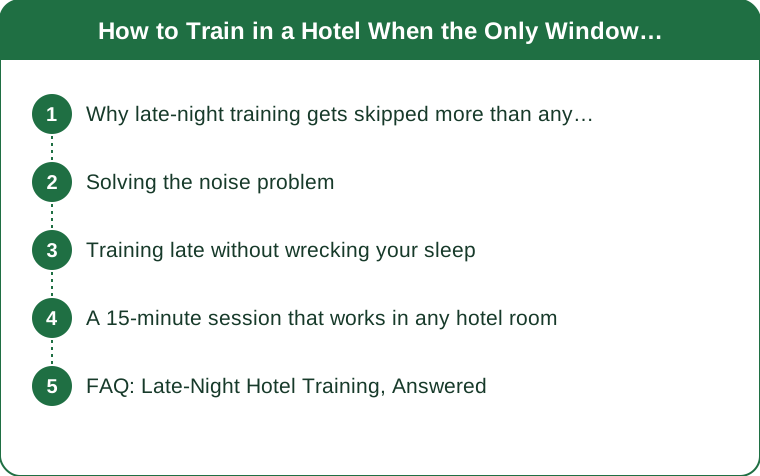
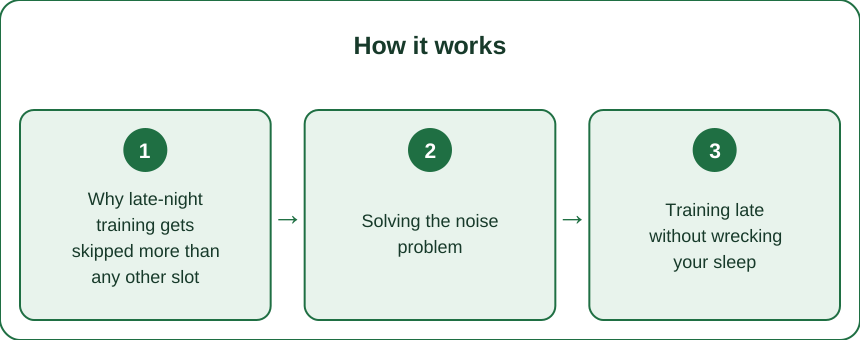
Why late-night training gets skipped more than any other slot
It is not a discipline problem, and treating it as one guarantees failure.
Decision fatigue is real and it peaks at the end of the day. Every choice you have made since the alarm has drawn down the same resource. A workout that requires a decision at 10pm is competing at your weakest moment.
The social structure of work travel fights you. Dinners run long, colleagues suggest one more drink, and declining has a social cost that a home evening does not carry.
Hotel rooms actively discourage movement. Limited floor space, furniture you cannot move, thin walls, and neighbours produce real constraints on top of the psychological ones.
And you have a legitimate reason to skip. After a travel day, skipping is often the correct call. The problem is that “tonight is legitimately a skip night” becomes every night by day three.
The reframe that works: decide the minimum session in advance, before the evening starts, and make it small enough that a genuinely tired person would still do it. Ten minutes of mobility and bodyweight work counts. The goal on a hard travel day is maintaining the habit, not hitting a training target.
Solving the noise problem
This is the practical constraint people underestimate, and it kills more hotel sessions than fatigue does.
Impact is what travels. Jumping, running in place, burpees, and anything with a landing produce structure-borne noise that carries clearly to the room below. At 10pm, that is a genuine problem and a legitimate complaint.
Isometrics are silent and genuinely effective. Planks, wall sits, split squat holds, glute bridge holds, and hollow body holds all produce real training stimulus with no noise at all.
Slow tempo work replaces impact well. A bodyweight squat performed with a three-second descent and a two-second pause is demanding, silent, and takes no space.
Resistance bands are the ideal travel tool for this reason. They weigh nothing, pack flat, provide meaningful resistance, and make no noise. If you travel regularly and train in rooms, a set of bands is the single best purchase available.
Use the bed and a towel rather than the floor where possible. Working on a bed for glute bridges and core work removes the last of the transmitted noise, and a towel under the hands or knees dampens the rest.
Avoid dropping anything at all. A dumbbell set down heavily at 10.15pm is the one thing guaranteed to produce a phone call from reception.
Training late without wrecking your sleep
The evidence here is less alarming than the standard advice suggests, but the individual variation is large.
Exercise raises core temperature, heart rate, and arousal, all of which oppose sleep onset. But research on evening exercise generally finds it does not impair sleep for most people, and moderate evening exercise may improve sleep quality overall.
High-intensity work finishing very close to bedtime is the case where problems appear. If you are going to train hard, finishing 60-90 minutes before you intend to sleep gives core temperature time to fall, which is itself a sleep-promoting signal.
Individual response varies enormously. Some people sleep beautifully after a 10pm session; others lie awake for two hours. Test it and believe your own experience over general advice.
Bias late sessions toward strength and mobility rather than conditioning. A resistance session is less arousing than intervals, and mobility work is actively calming.
A hot shower afterwards genuinely helps. It accelerates the core temperature drop through peripheral vasodilation, which supports sleep onset.
Skip pre-workout stimulants entirely. Caffeine has a half-life of around five hours, which means a pre-workout at 10pm is still substantially present at 3am. On a trip where sleep is already compromised, this is the easiest possible thing to get right.
And when jet-lagged, prioritise sleep timing over the session. If it is 10pm locally and your body thinks it is 4am, sleep is the higher-value activity. That is not skipping; it is correct sequencing.
A 15-minute session that works in any hotel room
Low noise, no equipment, no space requirements.
Warm-up, 3 minutes. Slow bodyweight squats, arm circles, hip circles, and a few standing side bends. Enough to raise temperature without producing sweat you have to shower off.
Circuit, 3 rounds, roughly 9 minutes. Perform each for 40 seconds with 20 seconds transition:
- Tempo squat, three seconds down, one second pause, controlled up
- Push-up, hands elevated on the bed if needed
- Split squat hold, alternating legs each round
- Glute bridge, two-second squeeze at the top
- Plank
Finish, 3 minutes. Hip flexor stretch, thoracic rotation on the floor, and a few slow breathing cycles. This last part matters more on a travel day than the work itself - hours of sitting on planes and in meetings leave hips and thoracic spine genuinely stiff.
Scaling up: add rounds, slow the tempo further, or add a resistance band to the squats and push-ups. The structure does not need to change.
Scaling down on a genuinely brutal day: one round plus the finisher. Five minutes. The point is to preserve the habit across the trip so that the first session home is not a restart.
What this deliberately excludes: jumping, running, anything requiring floor space beyond a mat’s worth, and anything you could drop.
FAQ: Late-Night Hotel Training, Answered
Is working out at 10pm bad for sleep?
For most people, no - research generally finds evening exercise does not impair sleep, and moderate sessions may improve it. High-intensity work finishing right before bed is the exception. Aim to finish 60-90 minutes before sleep and see how you personally respond.
How do I work out in a hotel room without disturbing anyone?
Eliminate impact entirely. Isometric holds, slow tempo bodyweight work, resistance bands, and using the bed for floor exercises all produce genuine training stimulus with essentially no transmitted noise.
Is a 15-minute workout worth doing?
On a travel day, absolutely. The value is in maintaining the habit and preventing the week off that turns into three. A short session done consistently across a trip beats an ambitious plan abandoned on day two.
Should I train or sleep when I am jet-lagged?
Sleep, in the first day or two. Training on severe sleep deprivation produces poor quality work and delays adaptation to the new time zone. Once you are sleeping at local times, resume normally.
What equipment is actually worth packing?
A set of resistance bands and nothing else. They weigh almost nothing, provide real resistance for both upper and lower body, make no noise, and solve the hotel room constraint better than any other portable option.
TL;DR:
- Late sessions fail on decision fatigue, not discipline - pre-commit to a minimum before the evening starts.
- Impact is what the room below hears; isometrics, tempo work, and bands are silent and effective.
- Finishing 60-90 minutes before bed and taking a hot shower supports rather than harms sleep.
- Skip pre-workout caffeine entirely at 10pm - the half-life makes it a 3am problem.
- When genuinely jet-lagged, sleep is the higher-value session; that is sequencing, not skipping.
The 10pm workout does not need to be good. It needs to happen, quietly, in fifteen minutes, so that day four still has a habit to continue.
Keep Reading
This article is for general informational and styling purposes only. Fit, sizing, and product availability may vary.