The Hotel Room Workout for Rooms With No Floor Space
Quick Answer: City hotel rooms in Tokyo, New York, London and most of Europe frequently give you less than a metre of clear floor - not enough for a plank, let alone a burpee. The answer is a standing-only session: squats, split squats, calf raises, wall push-ups, standing core work, and isometrics, structured as 25 minutes of real work in a space the size of a bath mat. You need floor for about a third of standard exercises, and the other two thirds are unaffected.
No mat, no lying down, no moving the furniture.
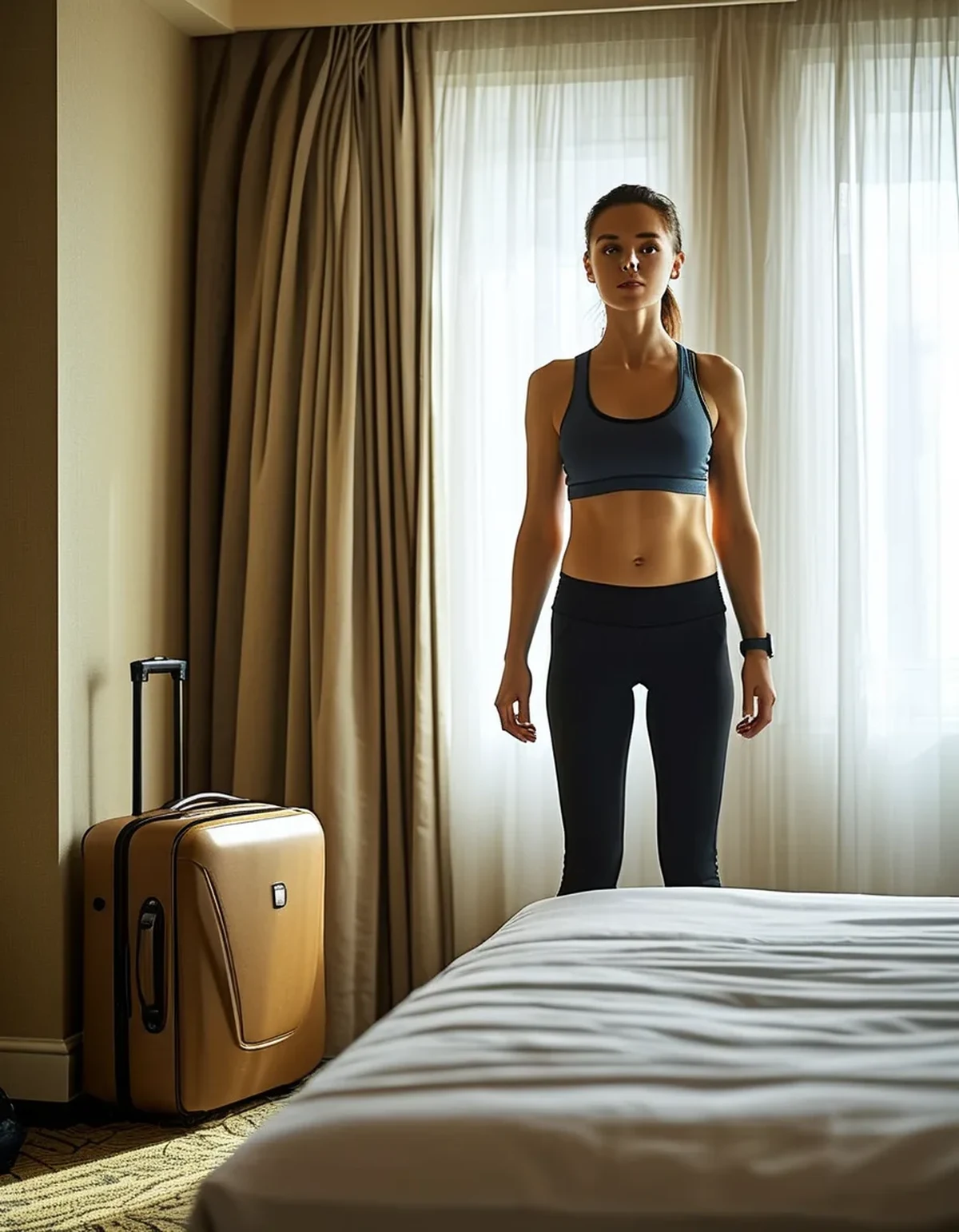
How much space do you actually have?
Before you plan anything, measure it in the only unit that matters.
The test: stand with your feet hip-width apart and hold your arms out to the sides. If you can turn 360 degrees without hitting anything, you have enough space for everything below. That is roughly a 1.2m circle, and it is a much lower bar than most workouts assume.
What that space rules out: anything prone or supine - planks, push-ups on the floor, glute bridges, bicycle crunches, dead bugs. Anything travelling - lunges walking forward, bear crawls. Anything jumping, which is usually a noise problem before it is a space problem anyway.
What it still permits, which is more than people expect:
- Every squat variation including split squats and single-leg work
- All standing hinge patterns - good mornings, single-leg deadlifts
- Push-ups against a wall or the desk, which are genuinely effective at the right angle
- Standing core work, which is underrated and does not need a floor at all
- Isometrics, which need no space in any direction
- Step-ups onto a sturdy chair, if the room has one that is safe
The furniture is your equipment. The bed edge, the desk, the wall, and the doorframe together cover most of what a set of dumbbells would do, and none of them can be forgotten at home.
The 25-minute standing session
Three blocks, no floor, no equipment. Work 40 seconds, rest 20, and go straight through each block before resting a minute.
Block 1 - Legs (3 rounds)
- Bodyweight squats, slow on the way down, three seconds
- Split squat, left - rear foot on the floor, not elevated, if space is tight
- Split squat, right
- Calf raises, pausing at the top
Block 2 - Upper body (3 rounds)
- Desk or wall push-ups - the lower the surface, the harder it is, so use the desk before the wall if you can
- Doorframe rows - grip both sides of a doorframe, lean back with straight arms, pull yourself upright. This is the closest you get to a pulling movement in a hotel room and it matters, because everything else here pushes
- Wall angels - back against the wall, arms sliding up and down while maintaining contact. Far harder than it looks after a long flight
- Isometric wall press - push into the wall at chest height for the full 40 seconds
Block 3 - Core and conditioning (3 rounds)
- Standing marches with a knee drive, controlled rather than fast
- Standing side bends with a pause, which loads the obliques without a floor
- Wall sit, holding for the full 40 seconds
- Standing bicycle - opposite elbow to opposite knee, slowly, with an actual rotation through the ribs
The whole thing runs about 25 minutes and covers every major pattern except a horizontal pull, which the doorframe rows partly address.
What Nobody Tells You About Hotel Room Training
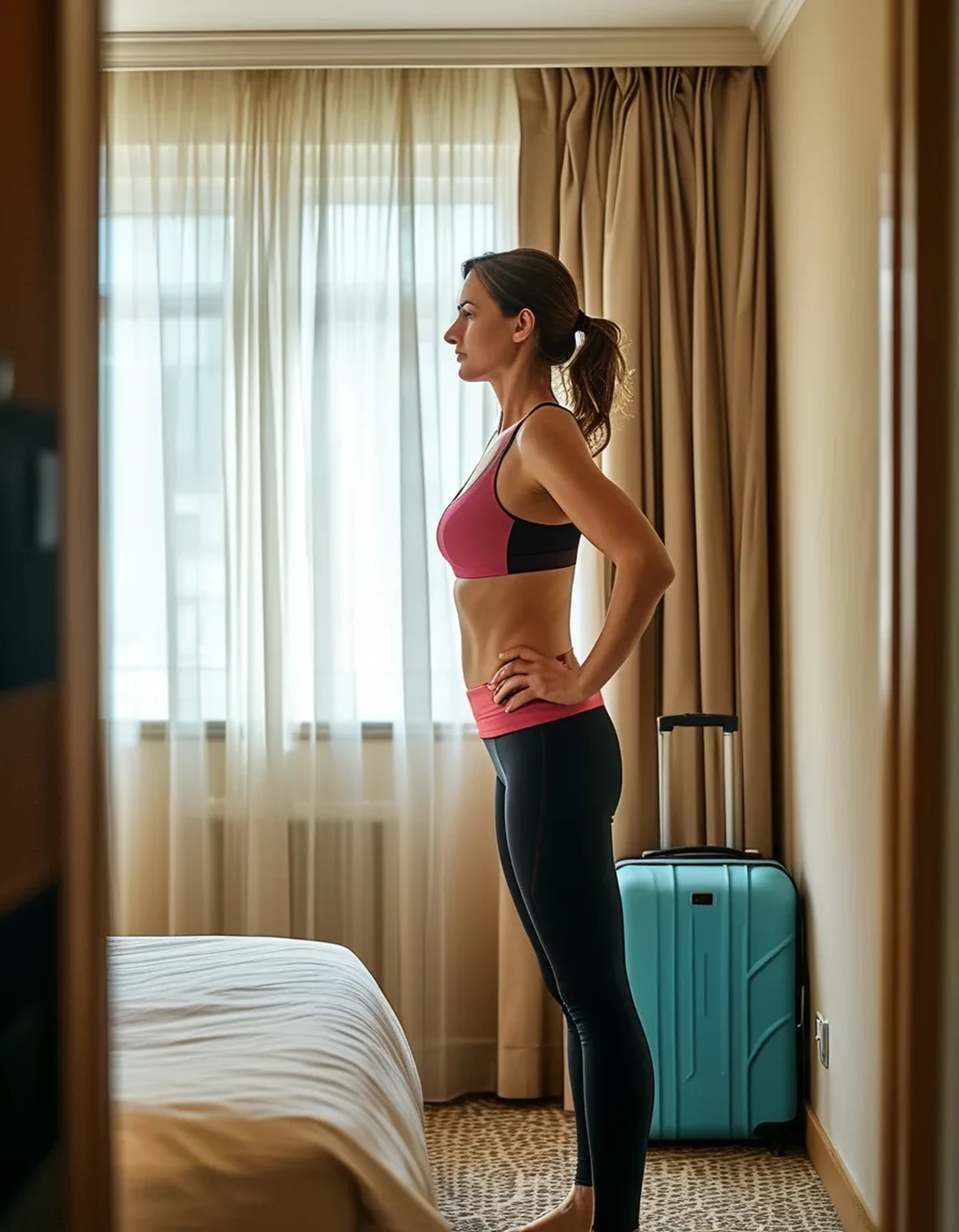
The floor is the least useful surface in the room. It is also usually the least clean, the noisiest to work on, and the one that requires the most space. Almost every exercise people miss the floor for has a standing equivalent that is equally effective and takes up a tenth of the room.
Isometrics travel better than anything else. A 40 second wall sit or wall press produces genuine effort with zero space, zero noise, and zero equipment. They are the most underused tool in travel training, largely because they look like nothing is happening.
Noise matters more than you plan for. The person below you hears impact, not effort. A standing session is almost silent by default, which makes it the right choice at 6am regardless of how much space you have.
The desk is better than the wall. For push-ups, the angle you get from a desk or the edge of a bathroom counter is substantially harder than the wall version, and most people go straight to the wall and find it too easy to bother with.
Do not use the bed for anything load-bearing. Hotel beds are soft, unstable, and frequently on castors. Step-ups onto a bed are how people injure ankles on work trips. The chair, if it is solid and does not swivel, is a much better option.
Three sessions beats one perfect one. On a four-day trip, three 25 minute standing sessions in the room will do more for you than one hotel gym session you make it to on day three - and the standing session has never once been cancelled because the gym was full or closed.
Making it harder when it starts to feel easy
The limiting factor in bodyweight training is load, and in a hotel room you cannot add any. So you change something else.
Tempo is the main dial. A squat taken down over five seconds with a two second pause at the bottom is a completely different exercise from a normal-speed squat, and it requires no additional space or equipment. This is the single most effective progression available to you.
Unilateral work doubles the load for free. Split squats, single-leg calf raises, and single-leg hinges all put close to twice the load through one leg. Any lower body exercise that feels too easy should become a single-leg version before you consider adding reps.
Reduce the leverage. For push-ups, move from wall to desk to a lower surface. Each step is a significant jump in difficulty and they cost nothing.
Extend the isometric holds. Going from 40 to 60 to 90 seconds on a wall sit is a real progression and is easy to track.
Use the suitcase. A packed carry-on typically weighs 8 to 10kg and is a perfectly good load for goblet squats, suitcase carries on the spot, and overhead presses. It is the most obvious piece of equipment in the room and almost nobody uses it.
FAQ: Small Hotel Room Workout Questions, Answered
Is a standing-only workout actually enough?
For maintaining strength and conditioning across a trip, comfortably yes. Over months as a sole training method you would miss horizontal pulling and heavy loading, but that is not what a hotel workout is for. The goal on a four-day trip is to arrive home in the same shape you left, and this does that.
What about the hotel gym?
Use it if you will actually go, which the evidence of most people’s trips suggests they will not. The room session has the advantage of removing every barrier between waking up and starting - no shoes, no lift, no waiting for equipment. Treat the gym as a bonus rather than the plan.
How do I keep it quiet for the room below?
Stay standing, keep both feet in contact with the floor, and avoid anything that involves landing. A standing session with no jumping is essentially inaudible downstairs. Keep the TV off and your phone timer on vibrate - the beeping is usually the loudest thing in the room.
TL;DR:
- A 1.2m circle is enough - roughly two thirds of useful exercises never need the floor
- Three blocks of 40 on, 20 off covers legs, upper body, and core in 25 minutes
- Doorframe rows are the only pulling movement available and worth including every time
- Progress with tempo, single-leg variations, and lower push-up surfaces, not more reps
- Your packed carry-on is 8 to 10kg of free load and nobody uses it
The cramped room is not the obstacle it looks like. Measure the circle you can turn in, run the three blocks, and the trip stops being a training gap.
Keep Reading
This article is for general informational and styling purposes only. Fit, sizing, and product availability may vary.