How to Train in a Hotel Room That's Either Freezing or Boiling
Quick Answer: Hotel rooms run either too hot (poor ventilation, sealed windows, heating you can’t disable) or too cold (aggressive air conditioning on a fixed schedule). In a hot room: shorter intervals, longer rests, lower-intensity strength work, and use the bathroom’s exhaust fan. In a cold room: longer warm-up, continuous circuits without rest gaps, and layers you keep on. The unit almost always has a fan-only mode — running the fan without heating or cooling is the most useful undocumented feature in hotel rooms.
You planned a 25-minute session. Ten minutes in, you’re either dripping in a room that won’t cool below 76°F, or shivering between sets under a vent you can’t redirect.
Both are common, both are fixable, and neither is a reason to skip.
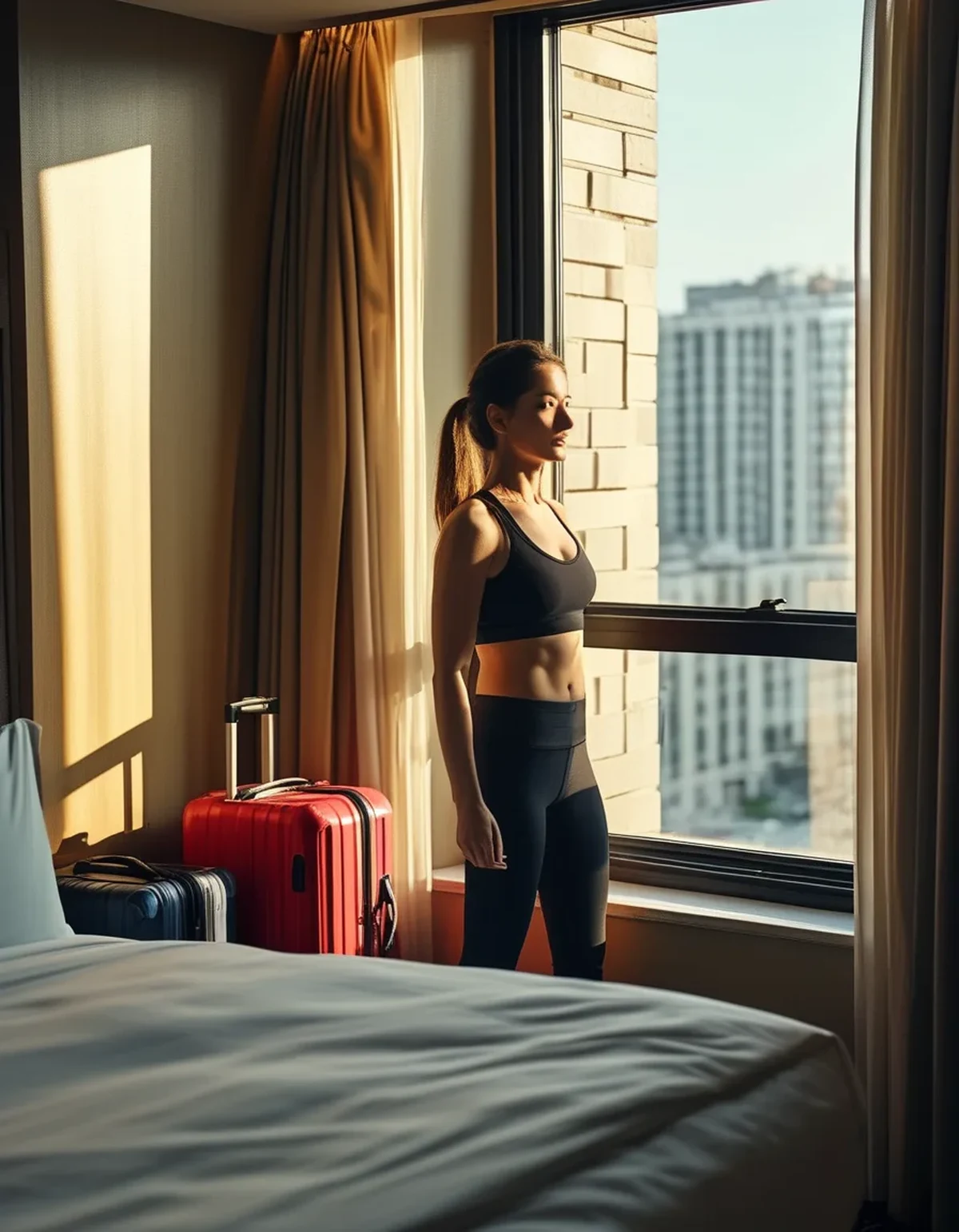
Why are hotel rooms so badly regulated?
Because most hotel HVAC is centrally controlled with a very limited local override, and the thermostat on your wall often does less than it appears to.
Many hotel thermostats have a restricted range — commonly 68 to 76°F — set by the property to control energy costs. Setting it to 60 does nothing beyond what 68 does.
Occupancy sensors shut systems off. Rooms with motion sensors will stop cooling or heating when they think you’ve left, which is why a room that was comfortable at 6am is stifling at 7am while you’re doing floor work and not triggering the sensor.
Seasonal changeover is central. Many buildings run either heating or cooling for the whole property, so in autumn a hotel may be heating when the outdoor temperature says cooling. You can’t override what isn’t available.
Windows rarely open in modern hotels, or open only a few inches for safety.
Understanding this saves time. Ten minutes of fighting a thermostat that has no authority is ten minutes of your session gone. Assume the temperature is a fixed constraint and design around it.
How do I train in a room that’s too hot?
Shift the work-to-rest ratio and drop the continuous-movement formats.
Longer rests, shorter work periods. 20 seconds work to 40 seconds rest rather than the reverse. You’ll do less total work in the same time, and the quality of each interval will be considerably higher.
Favor strength over conditioning. Push-ups, split squats, glute bridges, and planks generate far less heat than burpees and mountain climbers. A strength-biased session is the correct hot-room choice, and it’s usually the more useful session anyway.
Use the bathroom exhaust fan. It’s often the only genuinely functional air mover in the room, and running it with the bathroom door open creates real airflow. Combine with the HVAC fan-only setting.
Fan-only mode is the most underused hotel room feature. Most units have a fan setting that runs air circulation without heating or cooling. Air movement at the same temperature dramatically improves how a room feels during exercise because it enables evaporative cooling.
Train on the floor, not standing. Floor level is cooler in almost every room, and the difference is noticeable.
Hydrate more than the session seems to warrant. Hotel rooms are dry as well as hot, and travel dehydration compounds it. A bottle before and during, not just after.
How do I train in a room that’s too cold?
Longer warm-up, continuous circuits, and stop taking rest standing still.
Warm up for 10 minutes, not 3. Cold muscle produces less force and strains more easily, and hotel rooms at 64°F with a vent blowing are colder than they feel when you’re dressed.
Use continuous circuit formats. Moving from one exercise to the next without programmed rest keeps body temperature up. Six movements, 45 seconds each, minimal transition, three rounds — the format does the temperature regulation for you.
Keep a layer on for the first two rounds and shed it when you’re genuinely warm. The instinct to strip down immediately is what leaves you cold ten minutes in.
Redirect or block the vent if you safely can. A towel over a floor-level vent is often enough, and closing a directional ceiling vent’s louvers takes seconds. Don’t fully block anything you can’t easily restore.
Avoid the floor for stationary work. Cold hotel room floors are the specific reason people cut planks and stretching short. Use a towel or the bed for anything held.
Finish with something that keeps you warm, not a cool-down stretch on a cold floor. Stretch after a hot shower instead — better tissue temperature and considerably more pleasant.
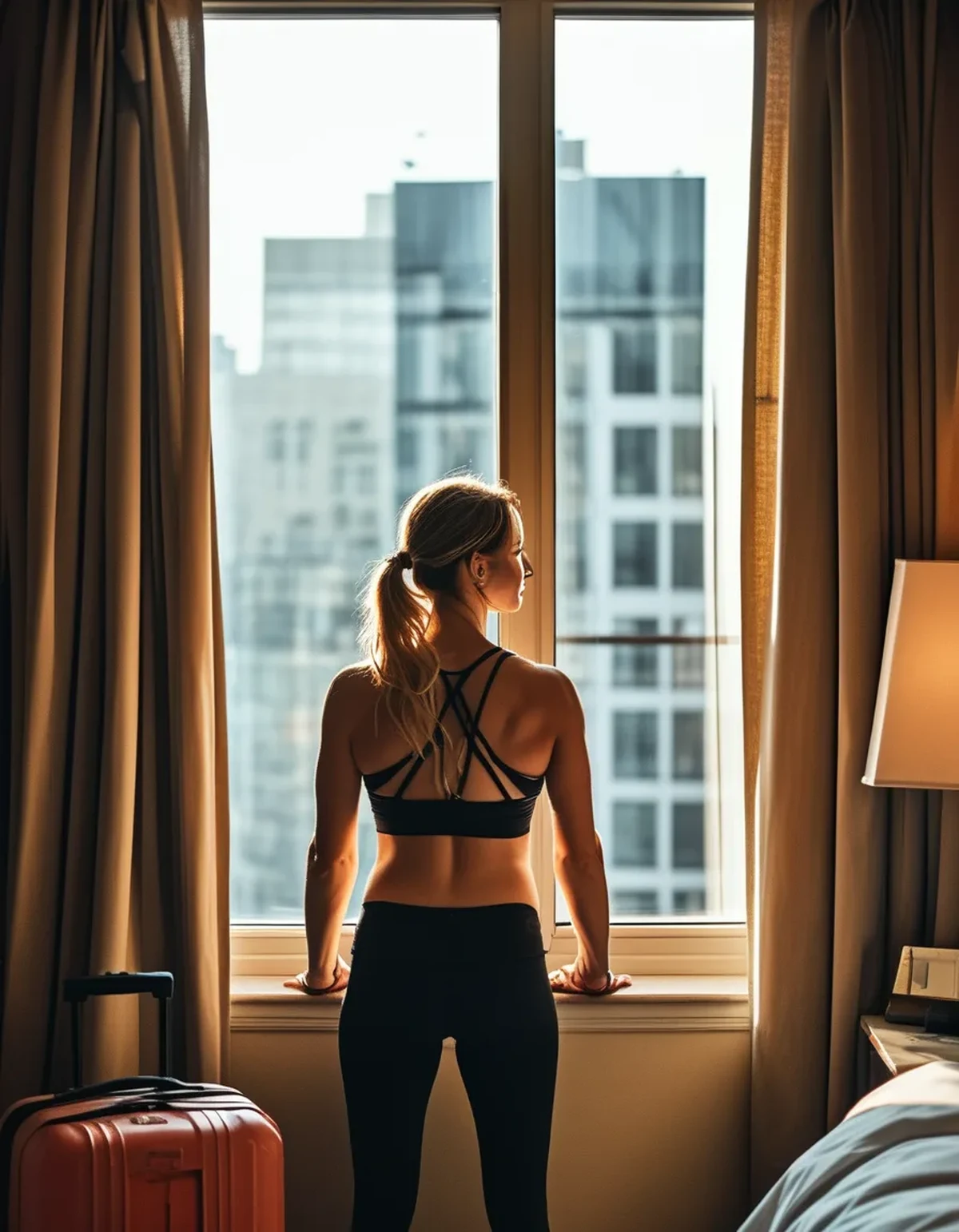
5 Hotel Room Workout Mistakes That Have Nothing to Do With Motivation
1. Fighting the thermostat instead of adjusting the workout. Most hotel thermostats have limited authority. Five minutes deciding the room is what it is, then adapting the session, gets you a workout. Twenty minutes troubleshooting gets you nothing.
2. Doing the same session regardless of the room. A burpee-heavy HIIT session in a 78°F sealed room is genuinely miserable and produces worse work than the strength session you’d have done instead. Match the format to the conditions.
3. Jumping in a room above someone else. This is an etiquette and noise issue and it’s also a practical one — you’ll be self-conscious and cut the session short. Low-impact formats solve both. Squats, lunges, push-ups, and isometrics make no noise at all.
4. Not checking the actual floor space first. Hotel rooms have less clear floor than they look. Move the chair and the luggage stand once, at the start, rather than working around them for twenty minutes.
5. Training at the wrong time relative to the room’s cycle. Rooms are typically coldest in early morning and warmest late afternoon, and central systems shift on schedules. If your first session was miserable, try a different hour before concluding the room is unusable.
What’s the equipment worth carrying?
Two items, and neither is a resistance band.
A pair of thin gloves or a small towel. Not for grip — for the floor. Hotel carpet is unpleasant for hands during push-ups and planks, and it’s the specific thing that shortens sessions.
A door anchor and a long band, if you’re checking a bag. Bands are genuinely useful and they’re also the thing most often packed and least often used. The honest version: bands help if you already have a band routine. If you don’t, they’ll stay in the bag.
Skip the jump rope in hotel rooms. Ceiling height and noise both rule it out. It’s a hotel stairwell or car park item, not a room item.
Your suitcase is a weight. A packed carry-on is typically 15 to 22 pounds and works for rows, goblet squats, and carries. Use what’s already there.
The bed and the desk chair are the two most useful pieces of equipment in the room — elevated push-ups, split squats, dips, and inverted positions all work off them. A room is a better gym than it looks; it’s the temperature that’s the actual constraint.
FAQ: Hotel Room Temperature Workout Questions, Answered
Can I ask the front desk to change the temperature?
Worth asking, and results vary. Some properties can adjust individual rooms; many can’t during seasonal changeover. Asking for a fan is often more productive than asking for a temperature change, and most hotels have them.
Is a hot room actually dangerous to train in?
A warm room is uncomfortable rather than dangerous for a short session, provided you hydrate and reduce intensity. Watch for the same signals as any heat situation — stopping sweating, dizziness, or nausea mean stop.
Should I use the hotel gym instead?
If it exists and is decent, yes — it’s usually better ventilated and you’ll train harder. The room workout exists for when the gym is closed, occupied, three floors away at 5am, or genuinely bad.
How do I avoid disturbing the room below?
Eliminate all jumping and dropping. Squats, lunges, push-ups, planks, glute bridges, and isometric holds are silent. Most of a good session is silent anyway — it’s the burpees and jump squats that carry.
What’s the minimum useful session in a difficult room?
Ten minutes of quality work beats nothing by a wide margin, and it protects the habit through a travel week, which is the real value. Three rounds of four movements is a legitimate session.
TL;DR: The room’s temperature is a fixed constraint. Design around it instead of fighting it.
- Hotel thermostats often have limited authority, and occupancy sensors shut systems off mid-session.
- Hot room: 20 seconds work, 40 rest, strength over conditioning, and use the bathroom exhaust fan.
- Cold room: 10-minute warm-up and continuous circuits with no standing rest, layers on for the first two rounds.
- Fan-only mode is the most useful undocumented feature in almost every hotel room.
- Train on the floor in a hot room, off the floor in a cold one.
- Your suitcase, the bed, and the desk chair are more useful than anything you’d pack.
Check for fan-only mode before your next hotel session. It takes ten seconds and it changes a hot room more than the thermostat will.
Keep Reading
This article is for general informational and styling purposes only. Fit, sizing, and product availability may vary.