The Layover Routine Nobody Notices You Doing
Quick Answer: The two things that matter most during a long layover are walking and hip extension — sitting shortens the hip flexors and shuts down the glutes, and both are what leave you stiff on the next flight. Walk the terminal for 15 minutes every hour, and add standing hip flexor stretches, calf raises and thoracic rotations that look like ordinary standing around. No floor, no mat, nobody watching.
The goal is not a workout. It is arriving able to move normally.
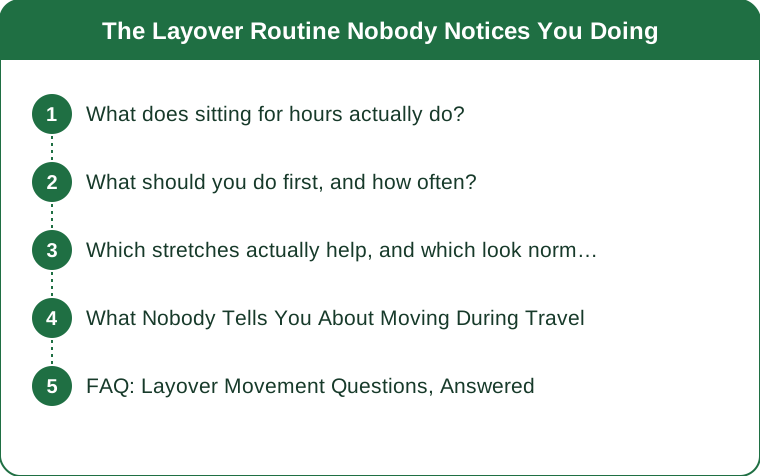
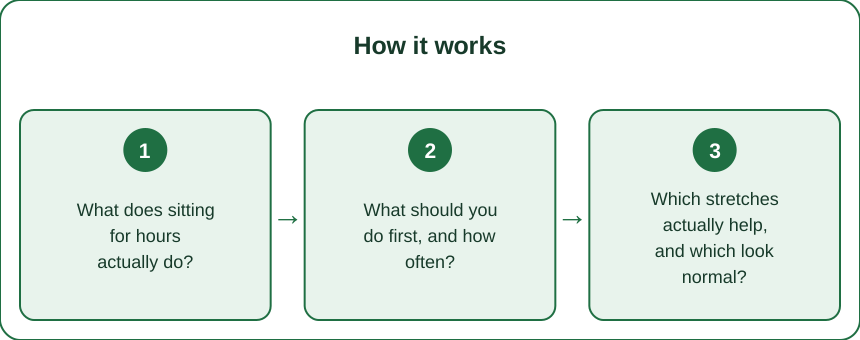
What does sitting for hours actually do?
Three specific things, and they compound with each additional hour.
Hip flexors shorten in a held position. Sitting places the hip at roughly 90 degrees for hours, and the tissue on the front of the hip adapts to that position. When you then stand and walk, the pelvis is pulled into a slightly different alignment, which is where a lot of post-travel lower back stiffness comes from.
Glutes stop firing. Prolonged sitting produces a well-documented reduction in glute activation. When the glutes are quiet, the lower back and hamstrings take over during walking, which is inefficient and uncomfortable.
Circulation slows in the lower legs. Blood pools, ankles swell, and the calf muscle pump — which normally moves venous blood back up the leg with every step — is inactive. This is the mechanism behind travel-related leg swelling and, in rare cases, more serious clotting concerns. Anyone with a history of clots or specific risk factors should talk to a clinician before long travel rather than relying on general advice. This is general information, not medical advice.
The thoracic spine stiffens too, particularly if you have been looking down at a phone or laptop. Rotation and extension are the movements you lose, and they are the ones that make reaching overhead into an overhead bin uncomfortable.
The good news: all four respond quickly to movement. Fifteen minutes of walking undoes a meaningful portion of two hours of sitting.
What should you do first, and how often?
Walk, and more often than you think.
The single highest-value action is walking. Not stretching, not exercises — walking. It restores circulation, activates the glutes, moves the hips through range, and requires no thought. Fifteen minutes of terminal walking per hour of layover is a reasonable target and is achievable in almost any airport.
Make it purposeful so you actually do it: walk to a further gate, walk to get water, take the long route to the restroom, skip the moving walkway. Deliberately choosing the inefficient path is the whole strategy.
Stairs, if the terminal has them. A few flights does more for hip extension and glute activation than any stretch, and it takes two minutes.
Carry your bag rather than rolling it for part of the walk. A loaded carry is a legitimate core and grip stimulus and it looks like nothing at all.
Frequency beats duration. Three 10-minute walks spread across a three-hour layover is considerably better than one 30-minute walk at the start, because the problem is the sustained sitting between them.
Which stretches actually help, and which look normal?
Four, all done standing, all indistinguishable from waiting for a flight.
Standing hip flexor stretch. Stand in a short split stance, tuck your tailbone under slightly, and squeeze the back glute. You should feel it at the front of the back hip. Hold 30 seconds each side. From two feet away this looks like standing with one foot forward.
Calf raises. Rise onto the balls of your feet, lower slowly, 15 to 20 reps. This directly activates the calf pump and moves pooled blood out of the lower legs. Do these at a counter, a window ledge or while waiting in any line.
Standing thoracic rotation. Hands loosely clasped at chest height, rotate the ribcage left and right, keeping the hips facing forward. Ten each way. Restores the rotation lost to hours of forward posture.
Doorway or wall chest stretch. Forearm on a wall or a pillar at shoulder height, rotate the body away. Thirty seconds each side. Counters the rounded shoulder position of sitting with a bag on your lap.
One more that is worth it if you can find a quiet corner: a wall sit for 30 to 45 seconds. It is genuinely uncomfortable and it wakes up everything from the hips down. Near a gate that is not boarding, nobody notices.
What to skip: anything requiring the floor. Airport floors are not where you want your face or your hands, and getting down and up in a busy terminal with luggage is more trouble than the stretch is worth.
What Nobody Tells You About Moving During Travel
Hydration does more for how you feel than any stretch. Cabin air is extremely dry, typically below 20 percent humidity, and mild dehydration amplifies stiffness, headache and fatigue. A full water bottle filled after security is the highest-return item in your bag.
Compression socks are genuinely effective for leg swelling on long flights and are cheap. They are not a fashion statement anyone is looking at, and the difference on arrival is noticeable for most people.
Shoes matter more on travel days than almost any other day. You will walk more than you expect in a terminal, then sit with swollen feet. Shoes that fit at 6am can be uncomfortable at 4pm. Slightly roomier is the right call.
The layover is a better movement opportunity than the destination. The intention to work out on arrival competes with fatigue, time zones and check-in. Movement during the layover competes with sitting and scrolling, which is a much easier competition to win.
And the honest one: nobody in an airport is watching you. Everyone is tired, looking at a screen, or watching a departure board. The self-consciousness that stops people from doing calf raises at a gate is entirely imagined, and the people who do stretch in terminals are noticed considerably less than they think.
FAQ: Layover Movement Questions, Answered
Is it worth using an airport gym or lounge shower?
If the layover is over three hours and the facility is convenient, yes — a shower alone substantially improves how you feel for the next flight. A full workout is usually not worth the logistics unless you are traveling light.
What about doing this on the plane?
Calf raises while standing in the galley area, ankle circles at your seat, and a walk up and down the aisle every hour or two are all reasonable and are actively encouraged by most airlines on long flights.
Does any of this help with jet lag?
Movement and light exposure both help entrain your body clock. Walking near a window with natural light during a daytime layover does more for adjustment than the same walk down an interior corridor.
I have a short layover. What is the one thing to do?
Walk to your gate rather than taking the train or walkway, and do 20 calf raises while waiting to board. Two minutes, and it addresses the circulation piece, which is the part that matters most.
TL;DR:
- Walking is the highest-value action — aim for 15 minutes per hour of layover, spread out rather than in one block.
- Sitting shortens hip flexors, quiets the glutes and stalls lower leg circulation; movement reverses all three quickly.
- Standing hip flexor stretch, calf raises, thoracic rotation and a wall chest stretch cover it, all discreetly.
- Take stairs, carry your bag, and deliberately choose the longer route.
- Water and compression socks affect how you feel on arrival more than any stretch does.
The layover is the easiest workout window of the whole trip, and it is the one people reliably waste sitting at the gate.
Keep Reading
This article is for general informational and styling purposes only. Fit, sizing, and product availability may vary.